The calls we get are not about definitions. They are about safety. If you are asking how to file domestic violence case in Chennai, you likely need to know where to go tomorrow morning, what to carry, and how long it will take for the court to step in.
This guide walks you through the Protection of Women from Domestic Violence Act, 2005 as it is actually used in Chennai and across Tamil Nadu and Andhra Pradesh. It is written for women, including NRIs with South Indian ties, who need a clear route to court-backed protection, money relief, and residence security. Our family law services page sets out the remedies available in each of these situations.
What You Can Get Under The PWDVA
The PWDVA is civil in design but enforced through criminal procedure. It gives you fast, practical reliefs from the Magistrate. You can seek a no-contact order, the right to live in your shared home, expenses and maintenance-like support, custody of children, and compensation for mental distress. Readers weighing a related question may also find our piece on Adultery as a Ground for Divorce in Chennai: What useful.
These orders work alongside any criminal complaint for cruelty under BNS Section 85 (formerly IPC 498A) and dowry recovery. Many women in Chennai file both tracks when facts justify it. The court will coordinate so the remedies do not overlap unfairly.
Legal Provisions That Apply
Protection of Women from Domestic Violence Act, 2005 governs the process. Section 12 lets you apply to the Magistrate for relief. Section 18 enables protection orders that restrain contact, violence, or communication. Section 19 covers residence orders so you can continue in the shared household or get alternate accommodation. A closely related situation is covered in our article on Annulment of Marriage vs Divorce in Chennai: Grounds, Procedure,.
Section 20 provides monetary relief for expenses and losses, including maintenance-like support. Section 21 allows temporary child custody. Section 22 permits compensation for mental and physical injury. Section 23 lets the Magistrate grant interim, even ex parte, orders in urgent cases.
For criminal cruelty, BNS Section 85 applies and is often used alongside a PWDVA case. If you also need summary maintenance, BNSS Section 144 offers a parallel route. Where jewellery and articles are withheld, Dowry Prohibition Act, 1961, Section 6 on stridhan return is useful. A breach of a protection order is an offence under PWDVA Section 31. Appeals from PWDVA orders go to the Sessions Court under Section 29.
Where And How To File In Chennai
You can file before the Metropolitan Magistrate Court that covers: where you live, where the respondent lives, or where the violence happened. In Chennai, applications are listed before the jurisdictional Metropolitan Magistrate benches. In Tamil Nadu districts and in Andhra Pradesh, the forum is the Judicial Magistrate of First Class.
You may file through the Protection Officer (Social Welfare Department) or directly through counsel. The Protection Officer can prepare the Domestic Incident Report (DIR), serve notices, and coordinate shelter and medical help. If an All Women Police Station is already involved, their papers can travel with your application.
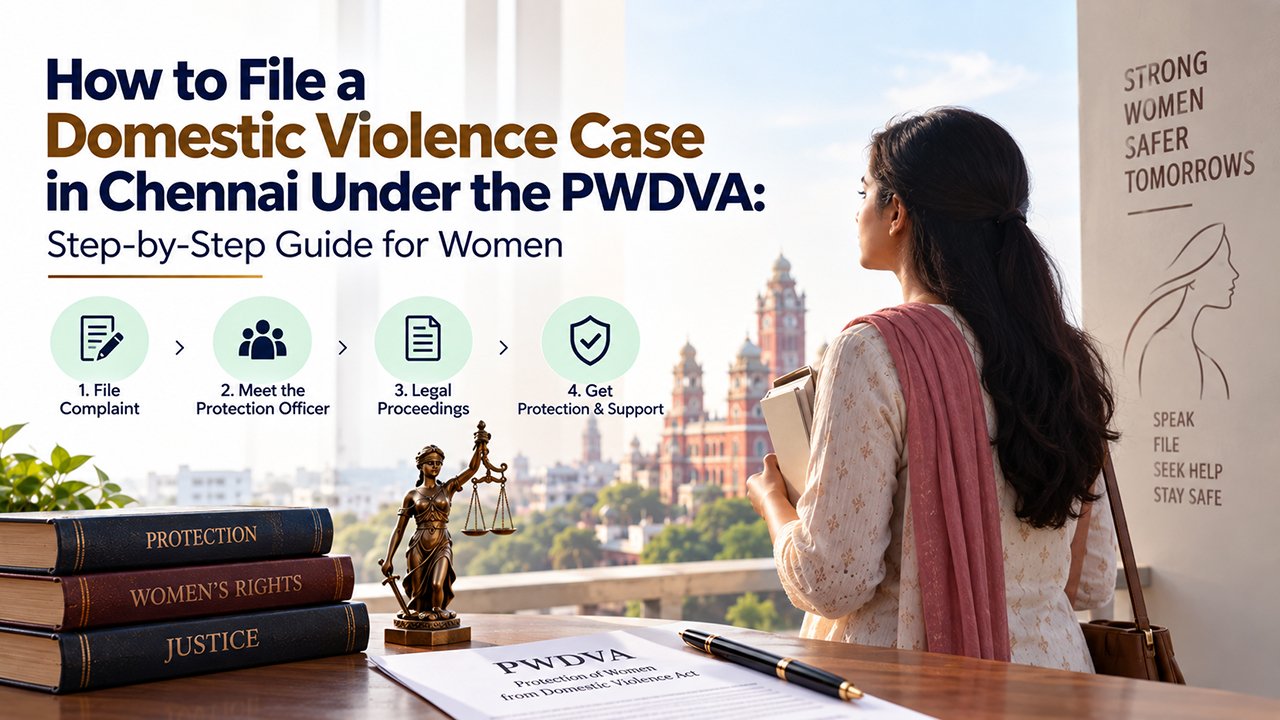
Step-By-Step: Filing Your Application
Immediate Safety And First Complaint
If you need urgent safety, go to the nearest All Women Police Station or call local police. Ask for a CSR or FIR, as the facts demand. Simultaneously, contact the district Protection Officer for a DIR and interim shelter if needed. Save messages, photos, medical notes, and witness details from neighbours or relatives.
Drafting And Filing Under Section 12
Your petition should clearly set out incidents, dates as best as you recall, the relationship, the shared household, and the specific reliefs under Sections 18 to 22. Include a prayer for interim protection under Section 23. There is no fixed domestic violence complaint format in practice, but Chennai courts expect an affidavit and a clean set of annexures.
If you also seek money relief, list monthly expenses child-wise and household-wise. Many benches in Chennai follow the Rajnesh v. Neha (2020) affidavit model and ask both sides to disclose income and assets. Be consistent across your PWDVA and any BNSS Section 144 maintenance filing.
Serving The Respondent And First Hearing
After scrutiny, the court issues notice. Service is through the Protection Officer or police. Unserved notices are the single biggest delay. Give accurate addresses, phone numbers, and work locations. The first hearing often focuses on interim relief and, if possible, settlement. Under the Family Courts Act culture of conciliation, many Magistrates attempt early mediation.
Interim Orders And Final Relief
Where danger is immediate, courts consider ex parte protection and residence orders under Section 23. Once the respondent appears, the court hears both sides on interim relief, then frames the schedule for evidence if final relief is contested. Breach of any protection order can be taken back to the same court under Section 31.
Timelines In Tamil Nadu And Andhra Pradesh
Interim protection is often considered quickly, sometimes within days, more often within a few weeks, depending on listing and service. Residence and custody directions are also taken up early when urgency is shown. The final case runs longer because evidence, cross-examination, and attempts at settlement take time.
Straightforward matters may conclude within several months. Contested evidence, parallel criminal proceedings, or repeated non-service can stretch the case beyond a year. Courts in Chennai, Coimbatore, Madurai, Tiruchirappalli and across Andhra Pradesh vary in diary load, so dates are spaced differently between benches.
Documents The Court Will Want
Bring what you have. Add more as you get it. Typical sets that Chennai Magistrates ask for include:
- Proof of marriage or domestic relationship, and proof of your present address in Tamil Nadu or Andhra Pradesh.
- Medical records, photographs, call recordings where lawful, and messages showing threats or abuse.
- Bank statements, rent agreements, school and medical bills to support monetary relief under Section 20.
- List of stridhan and receipts for jewellery or articles for recovery and for Dowry Prohibition Act Section 6 claims.
- Domestic Incident Report from the Protection Officer, if available, and copies of any CSR, FIR, or prior court orders.
- Birth certificates for children, and any existing custody or visitation directions.
File clean copies with an index. Courts prefer paginated sets. If you are abroad, scan and share with your counsel; notarised or apostilled copies can follow where the court asks.
Common Mistakes And Practical Tips
Waiting for the “perfect” proof set. Do not. File with what you have and seek interim protection; more documents can be filed later. Vague prayers also slow cases. Ask clearly for each head under Sections 18 to 22 and an interim order under Section 23.
Service failures cause repeated adjournments. Give multiple service addresses and share work timings. If maintenance is a key need, run a BNSS Section 144 case in parallel. If dowry articles are disputed, plead stridhan recovery with particulars. For criminal cruelty, remember that arrest is not automatic after Arnesh Kumar v. State of Bihar (2014), but breach of a protection order itself is actionable.
Some clients skip legal advice early and regret it. A short consult with an experienced family lawyer in Chennai can help frame the right reliefs and avoid contradictions across proceedings. If you are browsing our family law guides, you will also see neighbouring topics like Adultery as a Ground for Divorce in Chennai: What and Desertion as a Ground for Divorce in Chennai: How, which often intersect with abuse narratives.
Use the court’s conciliation window wisely. Where safe, structured settlements on residence and expenses can stabilise the situation while evidence proceeds. Keep every receipt and message. Consistency across affidavits matters; judges notice.
Conclusion
If you need to know how to file domestic violence case in Chennai, the route is through the Magistrate under the PWDVA, with protection, residence, and monetary relief available quickly in urgent cases. If you are unsure about your next step, speak to a family lawyer and plan the first filing carefully.
For counsel with South Indian court experience, the focus should be on clean facts, urgent interim relief, and workable service. If you prefer a local view before you act, our family law services and practical checklists are here to help. If you want a considered opinion on your papers, ask for an appointment with Advocate Manjula.
Frequently Asked Questions
Which court in Chennai should I approach for a PWDVA case?
File your application under Section 12 before the Metropolitan Magistrate having jurisdiction where you live, where the respondent lives, or where the violence occurred. In districts of Tamil Nadu and in Andhra Pradesh, it is the Judicial Magistrate of First Class. Protection Officers can route your complaint to the right court.
How quickly can I get an interim protection order in Chennai?
If there is urgency and your affidavit is clear, many Magistrates consider ex parte interim relief under Section 23 within days to a few weeks of filing, depending on court load and service of notice. Strong supporting material and a precise prayer clause help your case move faster.
Do I need a Domestic Incident Report (DIR) from the Protection Officer first?
A DIR helps but is not mandatory to file under Section 12. You can approach the Magistrate directly through counsel. Many Chennai courts still ask for the DIR during the first hearing, so initiating it with the Protection Officer in parallel avoids adjournments for paperwork.
Can I file in Chennai if the abuse happened abroad and I just returned?
Yes. The Act allows you to file where you currently reside in India. NRIs and returnees with a temporary address in Chennai often file here. Provide your local address proof and a brief note on when you came back. Facts of your stay and shared household history will matter.
Should I also file for maintenance under BNSS s.144 or rely on PWDVA monetary relief?
You can do both. Section 20 of the PWDVA permits monetary relief, while BNSS Section 144 offers summary maintenance. Many women file both in parallel. Courts adjust overlaps to avoid double recovery. Be consistent about income and expenses, and prepare the Rajnesh v. Neha asset affidavit.
What happens if he violates the protection order?
A breach of a protection order is an offence under Section 31 of the PWDVA. You can report it to the police or back to the Magistrate. For cruelty that continues, the police may also act under BNS Section 85 (formerly IPC 498A). Arnesh Kumar safeguards on arrest will still apply.