Call anytime
(+91) 98410 31719
Blog
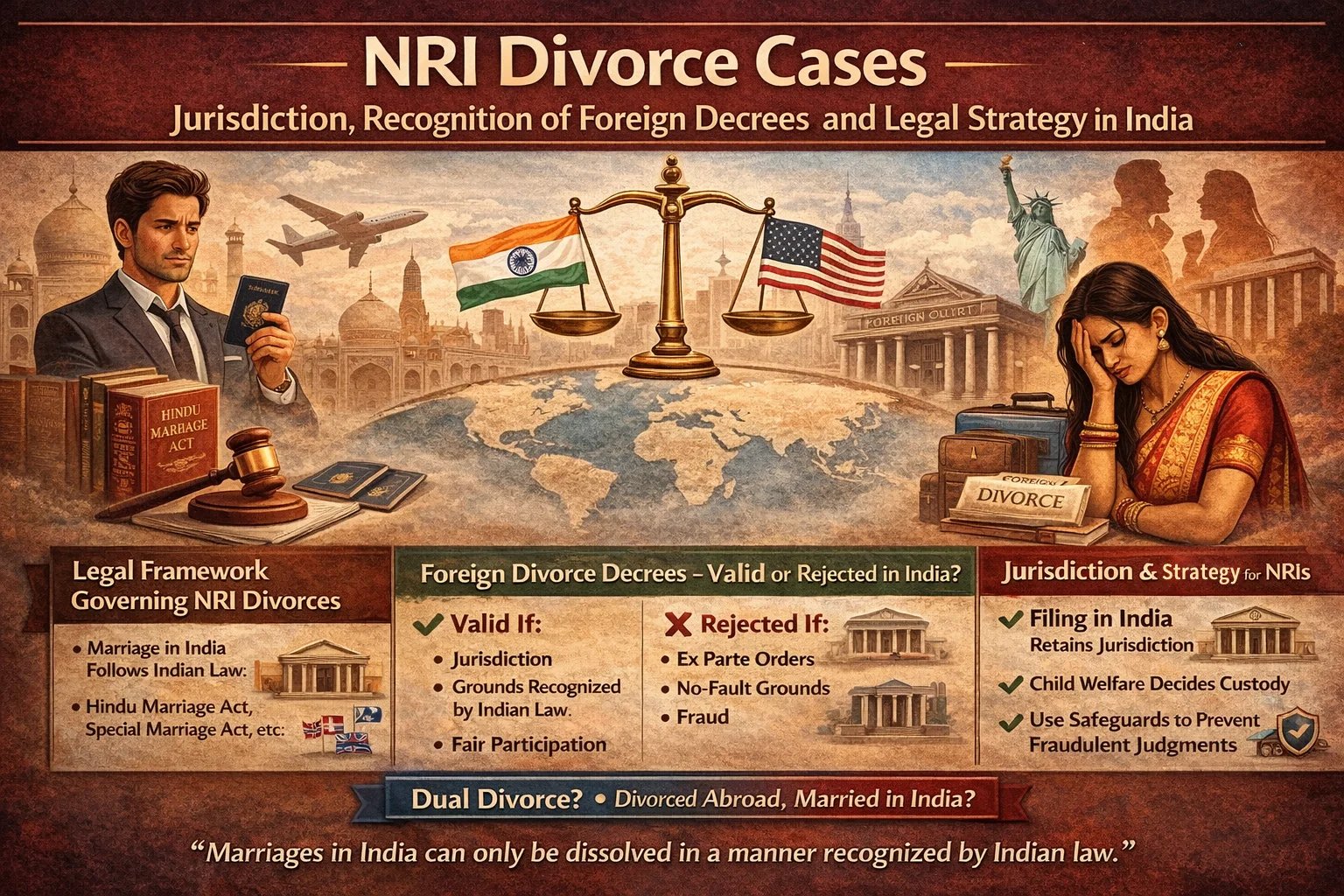
NRI Divorce Cases — Jurisdiction, Recognition of Foreign Decrees, and Legal Strategy in India
Marriages today often cross borders — an Indian citizen marrying an NRI, or two Indians settling abroad after marriage.
But when the relationship breaks down, the question of where to file for divorce and which court’s judgment is valid becomes complicated.
Indian law still governs the marriage, but foreign jurisdictions may also claim authority — leading to conflicting decrees, overlapping cases, and immense emotional and legal confusion
This article explains how Indian courts handle NRI divorces, when foreign decrees are recognized or rejected, and the strategic legal steps for spouses facing international matrimonial disputes.
More Detail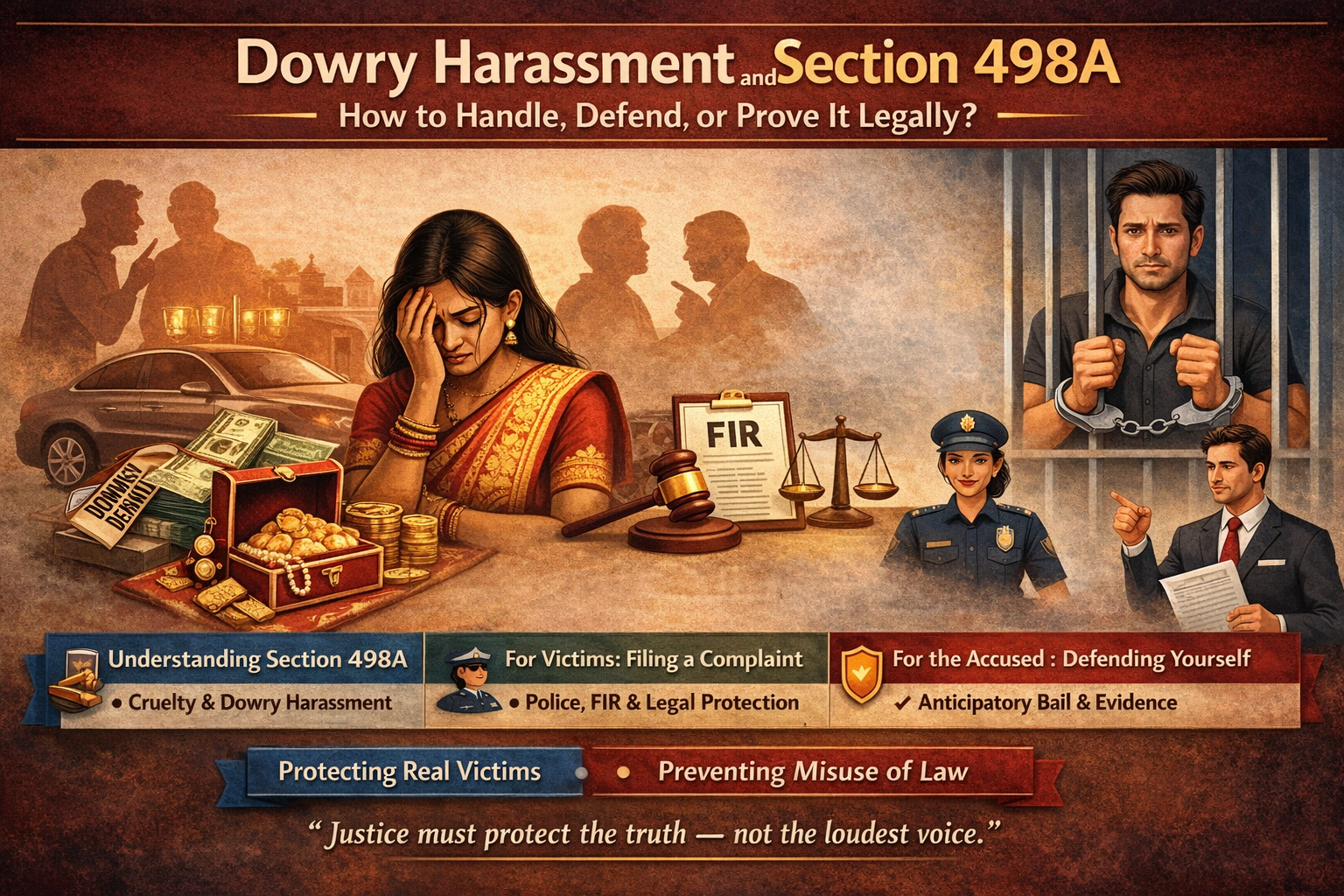
Dowry Harassment and Section 498A — How to Handle, Defend, or Prove It Legally ?
Dowry harassment cases under Section 498A of the Indian Penal Code represent one of the most painful intersections between law and emotion.
Introduced in 1983, this law was meant to protect women from cruelty, domestic abuse, and harassment in connection with dowry demands. But over time, misuse, exaggeration, and false cases have also surfaced — making it one of the most sensitive and contested provisions in Indian family law.
This article explains what Section 498A covers, how genuine victims can seek justice, and how falsely accused persons can defend themselves within the law.
More Detail
False Allegations and Legal Defences in Matrimonial Disputes — How to Protect Yourself and Prove the Truth in Court ?
Matrimonial disputes often begin with emotions — love, anger, betrayal — but once they reach the courtroom, allegations become evidence.
Unfortunately, some cases involve false or exaggerated claims — of cruelty, domestic violence, or dowry demand — made out of revenge, misunderstanding, or pressure. Such false accusations can destroy reputations, careers, and even families if not handled with care and legality.
The law protects genuine victims — but it equally protects those falsely accused, through proper defence, documentation, and judicial remedies.
This article explains how to recognize false allegations, how courts deal with them, and the strategic legal steps to defend yourself without fear or retaliation.
More Detail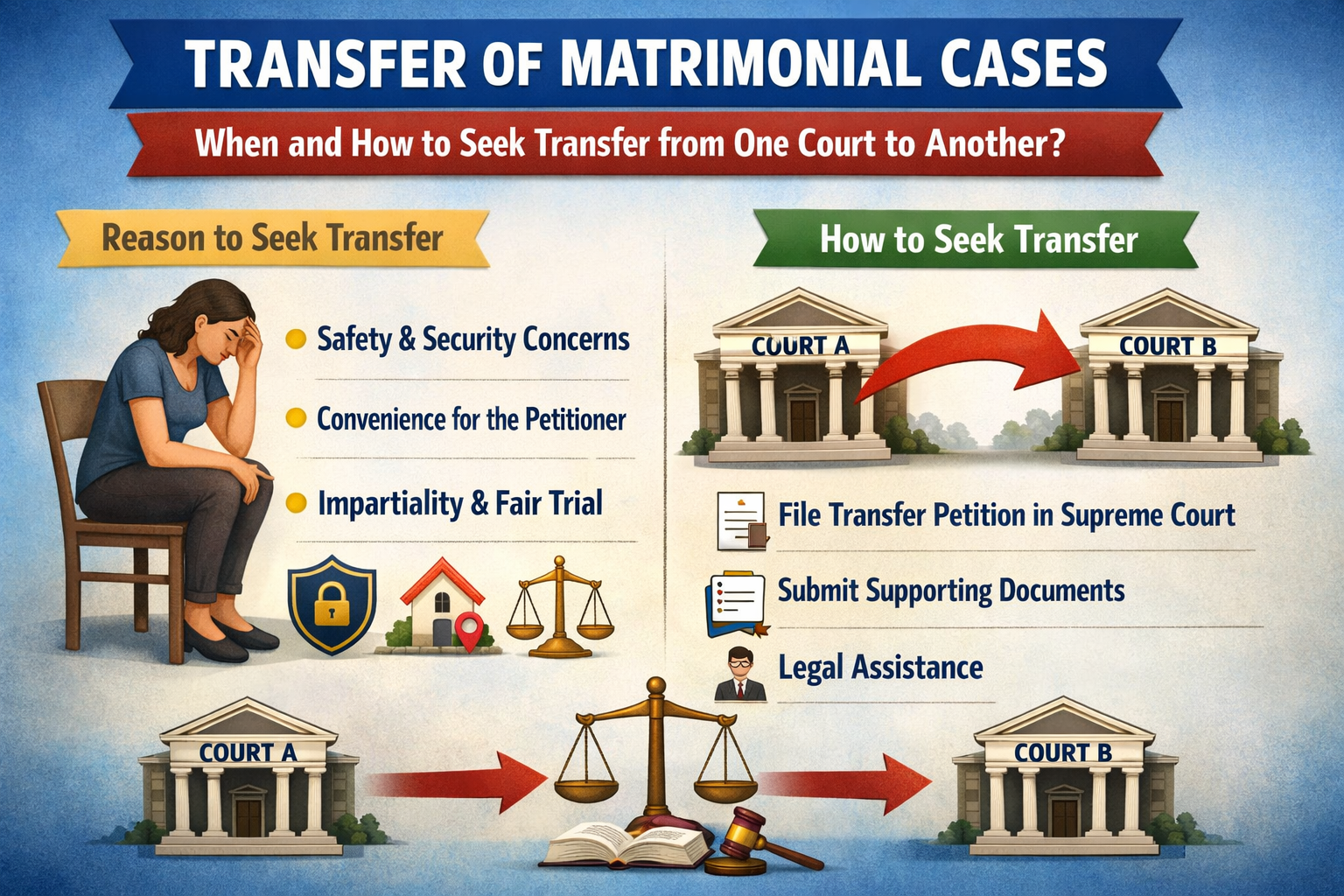
Transfer of Matrimonial Cases — When and How to Seek Transfer from One Court to Another ?
Matrimonial cases are deeply personal, but they often involve practical hardships — especially when one spouse files a case in a distant city or state.
For instance, a husband may file a divorce petition in his native place, while the wife lives and works in another city; or an NRI spouse may initiate proceedings abroad, leaving the other partner struggling to attend hearings.
To ensure fairness and accessibility, Indian law allows either party to seek a transfer of matrimonial proceedings from one court to another.
This article explains when such transfers can be requested, how the process works, and what the courts consider before granting them.
More Detail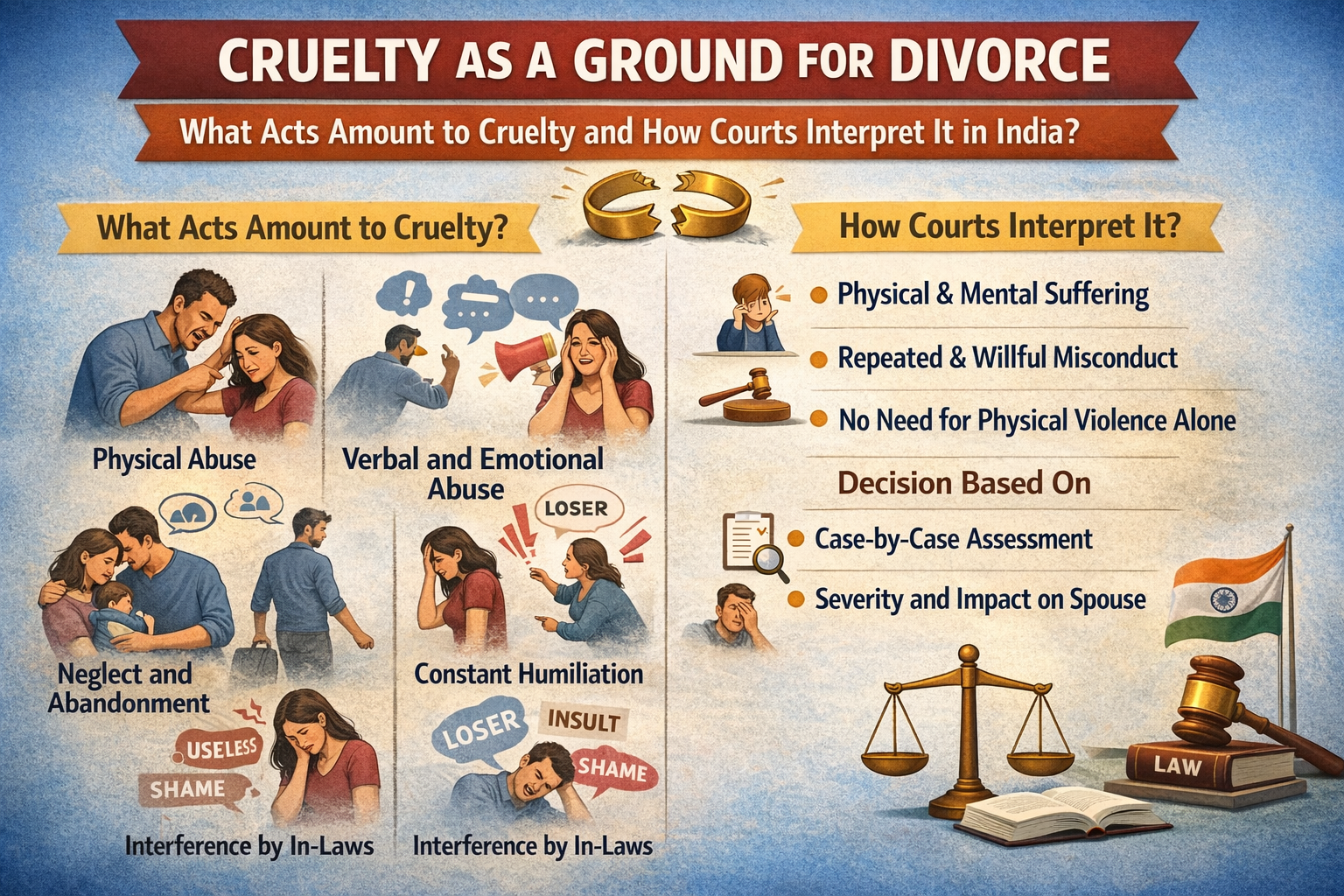
Cruelty as a Ground for Divorce — What Acts Amount to Cruelty and How Courts Interpret It in India ?
Marriage, in law and in life, is expected to be a relationship of mutual respect, companionship, and trust.
When one spouse’s conduct becomes so unbearable that the other can no longer reasonably live with them, the law calls it “cruelty.”
Cruelty has long been recognized as one of the key grounds for divorce in India.
But unlike physical assault, cruelty in law extends far beyond visible injuries — it includes emotional suffering, psychological abuse, and even the denial of affection or dignity.
This article explains what cruelty means in Indian matrimonial law, what acts constitute it, how courts interpret it, and what evidence is needed to prove it.
More Detail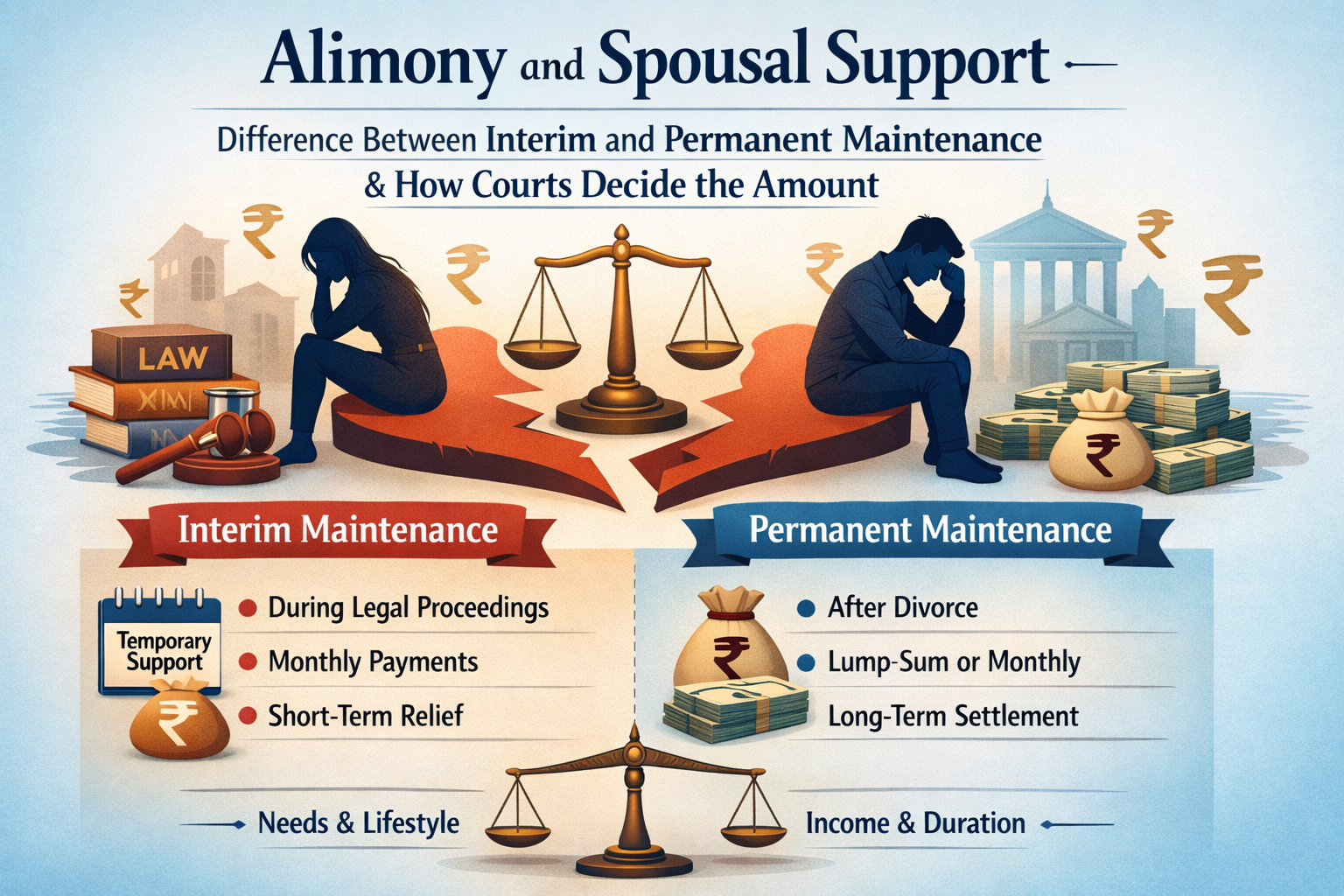
Alimony and Spousal Support — Difference Between Interim and Permanent Maintenance, and How Courts Decide the Amount
When a marriage breaks down, it’s not just the emotional bond that ends — often, one partner is left without financial security.
To ensure fairness and dignity after separation, Indian law provides for alimony and spousal maintenance, designed to prevent hardship and maintain balance between the two spouses.
This article explains the difference between interim and permanent maintenance, who can claim it, and how courts decide the amount.
More Detail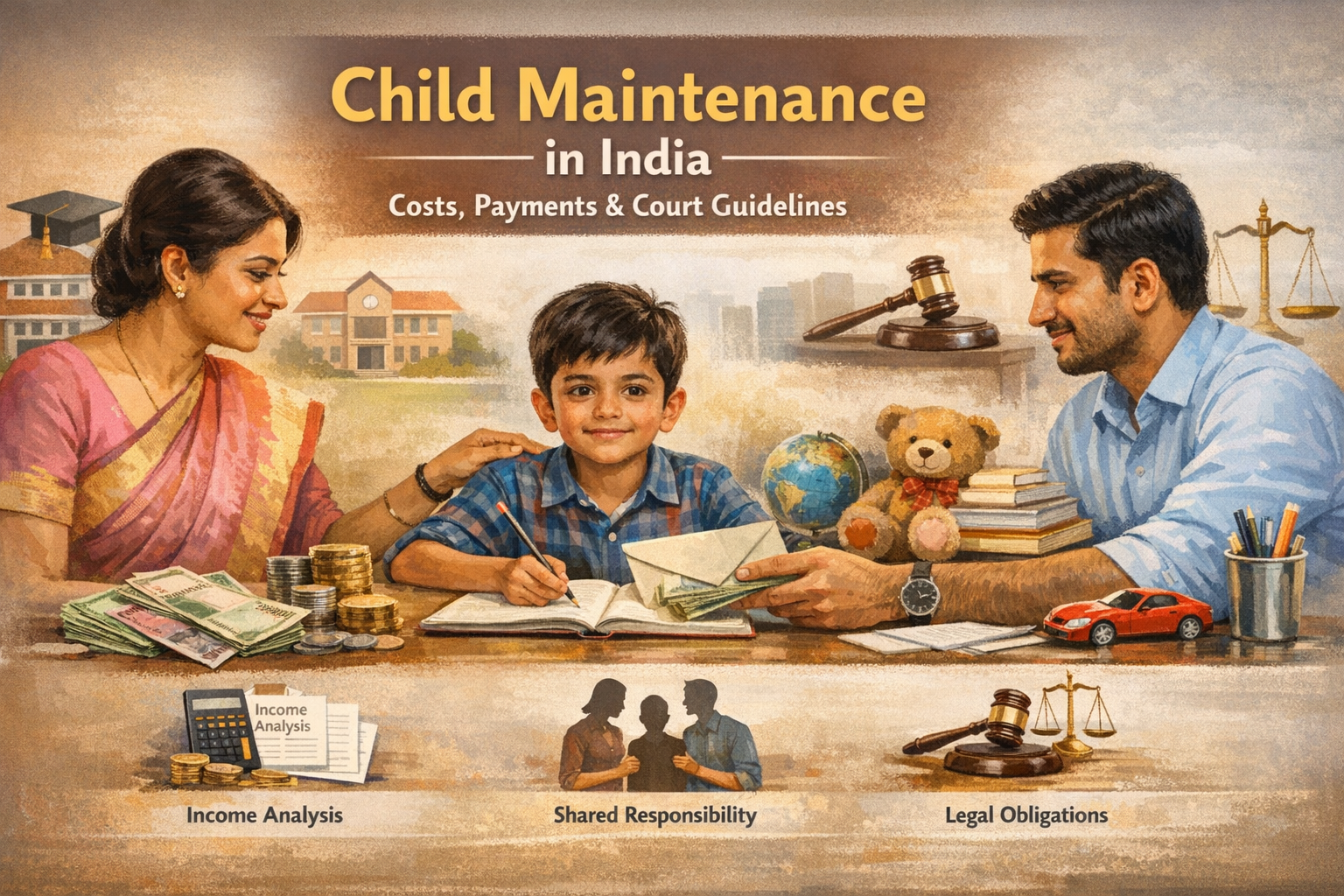
Child Maintenance — How It Is Calculated, Who Pays, and Key Court Guidelines in India
When a marriage ends, parental responsibility does not. Regardless of where a child lives — with the mother or father — both parents remain equally responsible for the child’s upbringing, education, and well-being.
To ensure that a child does not suffer financially due to the separation, Indian law provides for child maintenance — a legal obligation of one parent to contribute financially to the child’s care and development.
This article explains who pays child maintenance, how courts calculate it, and what factors determine the amount under Indian law.
More Detail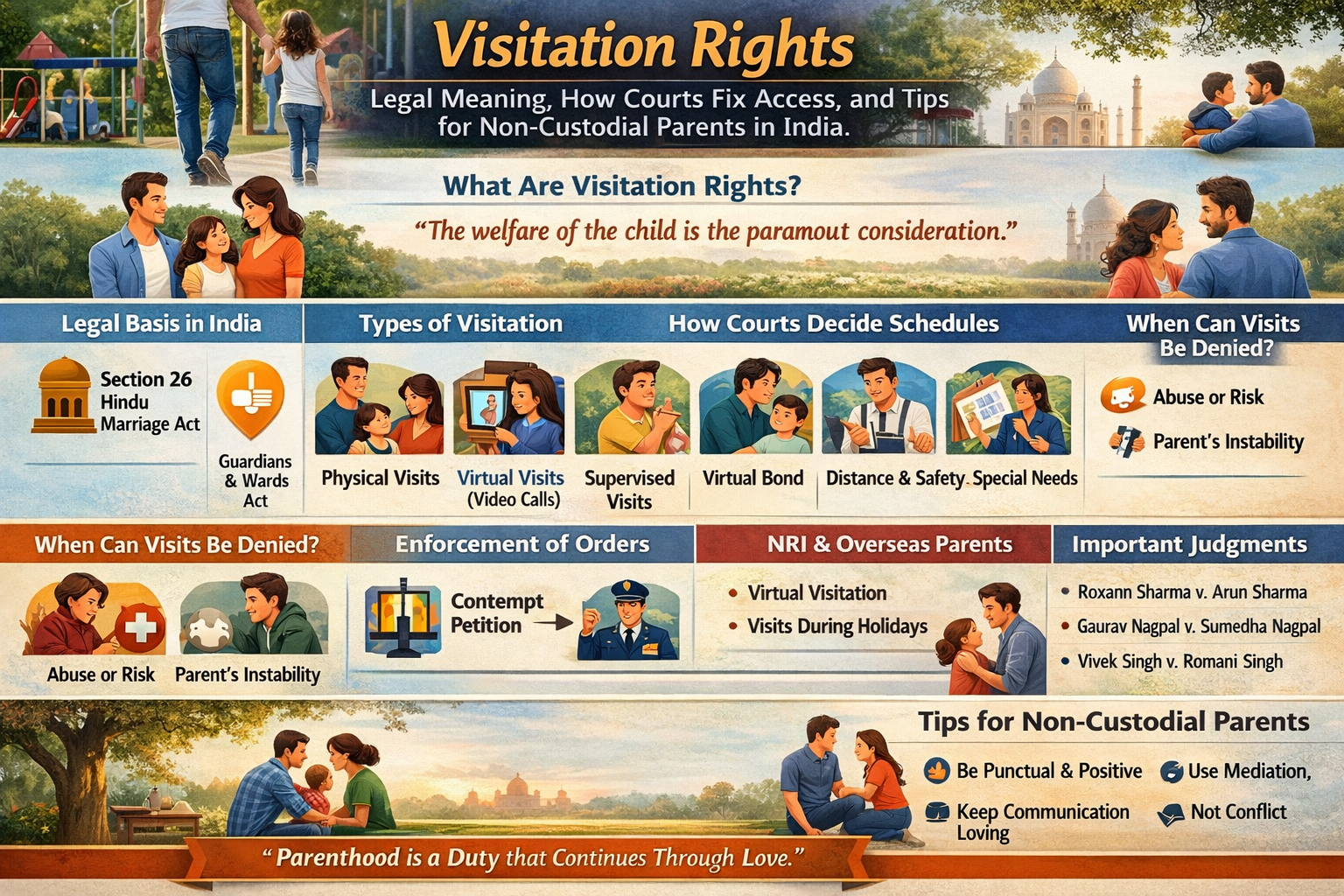
Visitation Rights — Legal Meaning, How Courts Fix Access, and Tips for Non-Custodial Parents in India
In every custody battle, one parent may win the right to keep the child — but the other parent does not lose parenthood.
The court recognizes that even after divorce or separation, a child has an equal right to the love, care, and presence of both parents.
That continuing bond is protected through visitation rights — a legal mechanism that ensures the non-custodial parent remains an active and meaningful part of the child’s life.
More Detail
Wife Threatening by Filing a False Domestic Violence Case — What You Should Know and How to Defend Yourself ?
The law against domestic violence was enacted to protect women from cruelty and abuse within marriage. It gives the courts power to provide quick and effective relief — residence, maintenance, and protection. But in some unfortunate cases, these provisions are misused.
Many men and their families find themselves suddenly facing a false domestic violence case, where allegations are exaggerated or fabricated to gain an advantage in matrimonial disputes, child custody issues, or property matters.
If you or your family are in such a situation, this guide explains how to act wisely, avoid unnecessary arrest, prove the falsity of the allegations, and safeguard yourself legally and personally.
More Detail
Restitution of Conjugal Rights — What It Means, When It’s Filed, and Whether It Really Helps in Saving a Marriage
In many matrimonial disputes, when one spouse leaves the matrimonial home and refuses to return, the other often feels hurt, confused, and desperate for reconciliation.
The immediate reaction for many is to say — “I will file a case to bring my spouse back.”
The legal remedy for that situation is known as Restitution of Conjugal Rights (RCR). It is one of the oldest concepts in matrimonial law — intended to protect the sanctity of marriage, but often misunderstood and sometimes misused.
This article explains what RCR truly means, how it works, what its consequences are, and whether it really helps in saving a broken marriage.
More Detail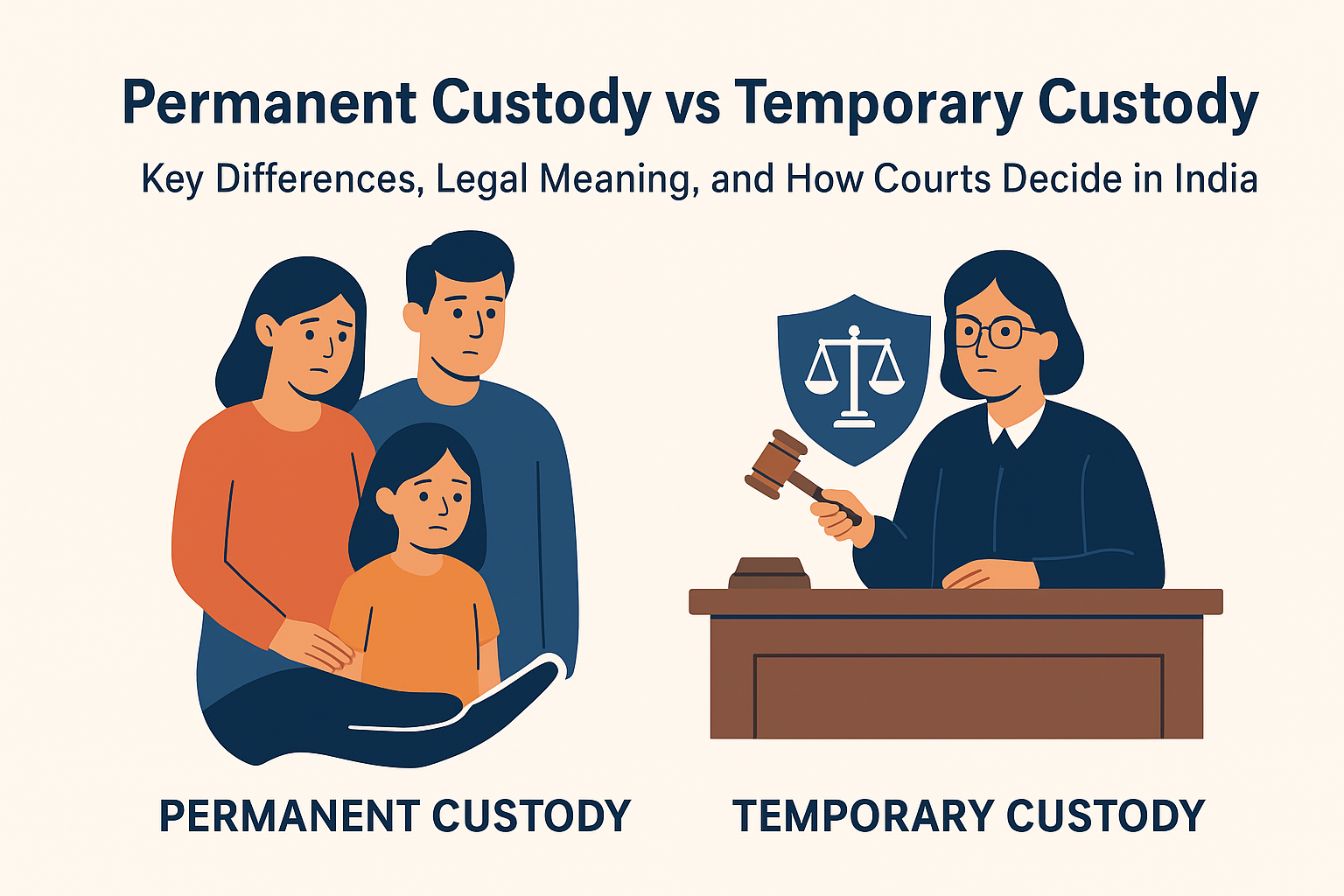
Permanent Custody vs. Temporary Custody — Key Differences, Legal Meaning, and How Courts Decide in India
Child custody is one of the most sensitive aspects of any divorce or separation case. Parents often hear terms like “interim custody,” “temporary custody,” and “permanent custody” in Family Court proceedings — yet very few fully understand what they legally mean.
In India, the difference between temporary custody and permanent custody lies not only in time but also in purpose, stability, and finality.
This article explains what each term means, how the courts decide custody duration and conditions, and why the phrase “permanent custody” has special importance — especially in documentation for schools, passports, and foreign travel.
More Detail
Mutual Consent Divorce for NRIs and Long-Distance Couples — Complete Legal Process, Documents, and Timeline
In many modern marriages, couples begin life together with the best intentions but grow apart due to distance, incompatibility, or cultural adjustments — especially when one or both partners live abroad.When both spouses accept that the marriage has broken down beyond repair, the most dignified and least painful path forward is Mutual Consent Divorce.
For Non-Resident Indians (NRIs) and long-distance couples, mutual consent divorce offers clarity, speed, and emotional closure — without unnecessary litigation.
Indian law has well-defined provisions for such cases, ensuring that justice and convenience can coexist even across borders.
More Detail
Mutual Consent Divorce — Step-by-Step Process, Timelines, and Common Mistakes to Avoid
Divorce is one of life’s hardest decisions. Yet, when both spouses agree that their marriage has reached its end and wish to part ways peacefully, the law offers a path of dignity and respect — the Mutual Consent Divorce.
It is the most straightforward, least confrontational, and often the fastest way to legally dissolve a marriage in India.
But it is also a process that requires understanding, cooperation, and careful timing.
This article explains how mutual consent divorce works, the procedure and timeline, and the common mistakes couples should avoid to ensure the process remains smooth and fair.
More Detail
Maintenance is Very Important for Women — Know Your Rights and How to Get It ?
When a marriage breaks down, many women suddenly find themselves without financial support. In such situations, maintenance becomes not just a legal remedy but a lifeline — a way to live with dignity and independence.
This article aims to guide you — clearly and practically — on how to claim maintenance, who is eligible, and what steps to take.
More Detail
Judicial Separation — Meaning, Difference from Divorce, and When It’s the Better Option ?
Marriage is meant to be a partnership of trust, companionship, and shared life.
But sometimes, when a relationship turns tense or painful, couples reach a stage where living together becomes impossible, yet they are not ready to end the marriage completely.
In such situations, Indian law provides a legal pause — a breathing space known as Judicial Separation.
It allows spouses to live apart legally without dissolving the marriage, giving them time and distance to decide the future.
This article explains what judicial separation means, how it differs from divorce, when it can be sought, and how courts treat it as a bridge between reconciliation and final dissolution.
More Detail
Irretrievable Breakdown of Marriage — When the Marriage Is Dead but Not Yet Legally Over ?
A marriage is built on companionship, trust, and shared life. But what happens when none of these survive — when a couple continues to be married only in law, but not in life?
Indian matrimonial law recognizes several grounds for divorce — cruelty, adultery, desertion, conversion, and so on. But sometimes, a marriage ends in every way except legally. No violence, no adultery, no visible fault — just complete emotional and practical separation.
This situation is called the “irretrievable breakdown of marriage.” It refers to a marriage that has died in substance but survives in form — where the bond has dissolved beyond repair, and continuing it serves no purpose but prolonged suffering.
More DetailIrretrievable Breakdown of Marriage — When the Marriage Is Dead but Not Yet Legally Over ?
A marriage is built on companionship, trust, and shared life. But what happens when none of these survive — when a couple continues to be married only in law, but not in life?
Indian matrimonial law recognizes several grounds for divorce — cruelty, adultery, desertion, conversion, and so on. But sometimes, a marriage ends in every way except legally. No violence, no adultery, no visible fault — just complete emotional and practical separation.
This situation is called the “irretrievable breakdown of marriage.” It refers to a marriage that has died in substance but survives in form — where the bond has dissolved beyond repair, and continuing it serves no purpose but prolonged suffering.
More Detail
Husband Is Not Paying Maintenance — What Can Be Done and How to Get Relief ?
It is painful and exhausting when a woman, already facing the strain of separation or divorce, must also fight to receive the very maintenance that the court has already granted. Many women find themselves in this situation — where the husband deliberately evades payment, drags the matter through repeated appeals, or simply refuses to obey court orders. Years go by, and not a single rupee reaches the hands of the person for whom the relief was meant.
This is not just a legal issue — it is a question of dignity, survival, and faith in justice. Fortunately, the law in India provides several remedies to deal with such non-compliance and ensure that justice is not defeated by delay.
More Detail
How to Transfer a Divorce Case from One City or State to Another — Procedure, Strategy, and Guidance for NRIs
In a country as vast and diverse as India, where spouses often live in different cities — or even different countries — it is common for one party to file a divorce case in a place that is inconvenient or practically impossible for the other to attend.
For example, a wife living in Chennai may file a case in her hometown in Kerala, or a husband working abroad may find himself summoned to appear in a small court somewhere in India. The distance, travel cost, and time difference make participation extremely difficult.
Fortunately, Indian law provides a clear and fair solution — you can apply to transfer your case to another city or state where it is more convenient, just, and practical to attend..
More Detail
How to Reopen or Challenge a Mutual Consent Divorce Decree — When One Spouse Claims It Was Forced, Misleading, or Fraudulent
Mutual consent divorce is meant to be a peaceful and dignified way for two individuals to part ways when their marriage has irretrievably broken down. It is built on three pillars — free will, mutual agreement, and informed consent.
However, in some rare situations, one spouse later claims that the consent was not truly mutual — that it was obtained by fraud, coercion, threat, or false promise. Sometimes, one party signs the documents in emotional distress or under misunderstanding about the settlement terms.
In such cases, Indian law allows the aggrieved spouse to challenge or reopen the mutual consent divorce decree — but only under specific and narrow grounds.
This article explains when and how such a decree can be set aside, what the courts look for, and how to approach such a sensitive situation lawfully and wisely.
More Detail
How to File for Divorce When Your Spouse Is Abroad or Missing — Procedure, Summons, and Practical Guidance for NRIs
In today’s global world, countless Indian marriages face an unusual challenge — one spouse is living abroad, and the relationship quietly breaks down across borders.
Sometimes, the spouse settles overseas and refuses to return to India. In other cases, they disappear without contact, leaving the other spouse emotionally and legally stranded.
When one party is abroad or missing, many people assume divorce is impossible. But Indian law has well-established procedures to handle such cases. The courts ensure that distance, disappearance, or foreign residence does not stop justice.
More Detail
Wife Not Allowing Husband to See the Child — Understanding Visitation Rights and Legal Remedies
In many matrimonial disputes, the most innocent victim is not the husband or the wife — it is the child.
When conflicts arise between parents, the child’s love, time, and emotional bond with one parent often become the casualty.
A common situation arises when the wife, in anger or bitterness, refuses to allow the husband to meet or speak with the child. Sometimes this continues for months or even years, leaving the father emotionally shattered and the child deprived of parental affection.
More Detail
What Happens If the Husband Stops Appearing in a Divorce Case — Legal Consequences and Remedies
Divorce cases in India often stretch over several years, and during this long journey, one party — usually the husband — may stop appearing in court.The reasons can be many: he may have moved abroad, lost interest, become financially strained, or simply felt exhausted by the prolonged litigation.Whatever the cause, non-appearance has serious legal consequences.
The Indian court system treats matrimonial disputes with utmost seriousness, and when one party chooses not to appear, the court proceeds on the principle that justice cannot wait for indefinite absence.
More Detail
When the Wife Is Denying Divorce or Deliberately Delaying the Case — What Are the Husband’s Legal Options?
Divorce is often not a sudden decision — it is the result of long years of emotional distance, incompatibility, or hardship. When a husband finally decides to take the legal route and seek divorce, he often faces a new challenge: the wife refuses to consent or deliberately delays the case.
Years pass, hearings drag on, and even interim issues like maintenance or custody consume endless time. The husband is left in legal limbo — neither free from the marriage nor able to move forward in life.
More Detail