Call anytime
(+91) 98410 31719
Blog Details
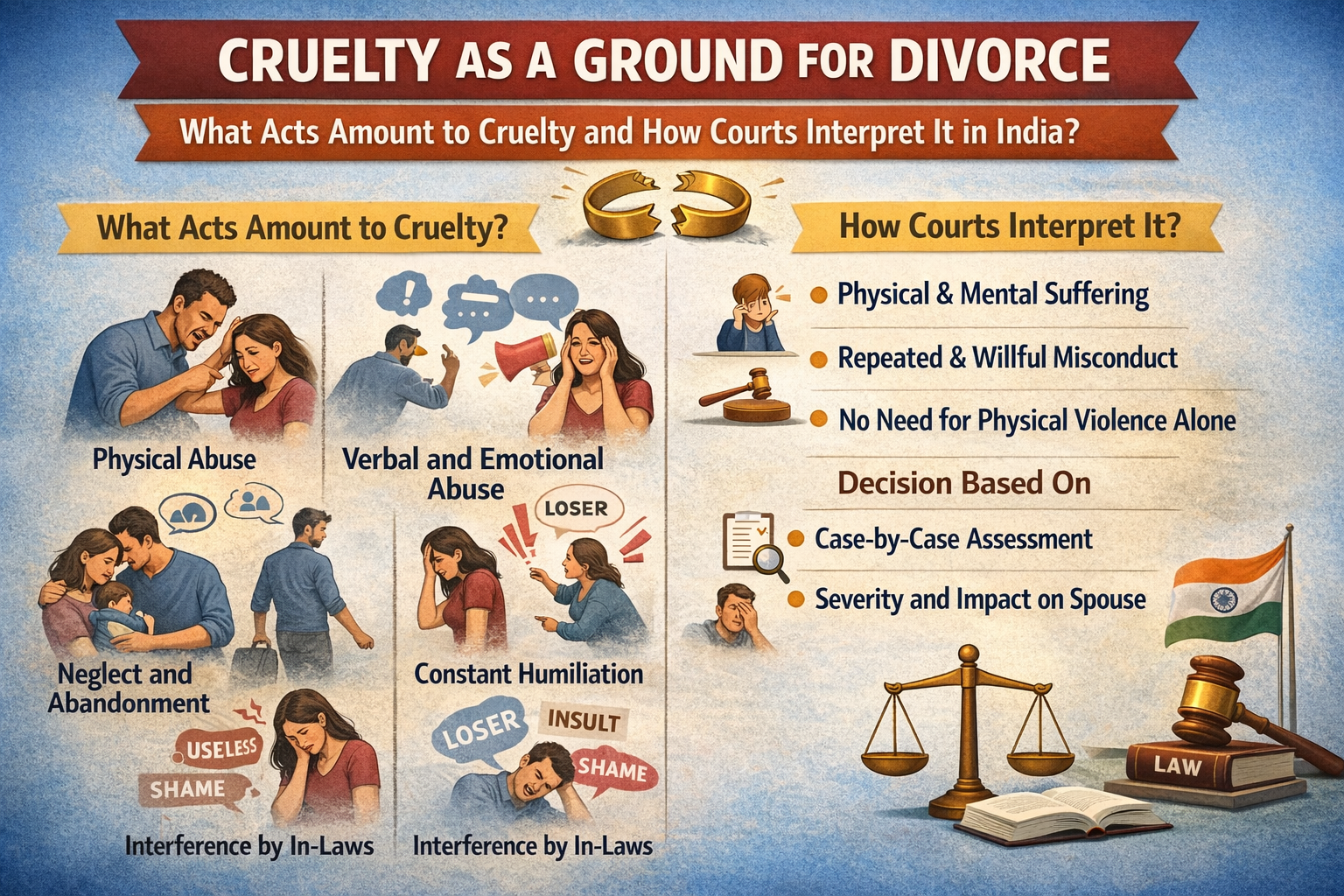
Cruelty as a Ground for Divorce — What Acts Amount to Cruelty and How Courts Interpret It in India ?
Marriage, in law and in life, is expected to be a relationship of mutual respect, companionship, and trust.
When one spouse’s conduct becomes so unbearable that the other can no longer reasonably live with them, the law calls it “cruelty.”
Cruelty has long been recognized as one of the key grounds for divorce in India.
But unlike physical assault, cruelty in law extends far beyond visible injuries — it includes emotional suffering, psychological abuse, and even the denial of affection or dignity.
This article explains what cruelty means in Indian matrimonial law, what acts constitute it, how courts interpret it, and what evidence is needed to prove it.
1. Legal Foundation of Cruelty as a Ground for Divorce
Under Section 13(1)(ia) of the Hindu Marriage Act, 1955, either spouse may seek divorce on the ground that the other has treated them with cruelty.
Similar provisions exist in:
- Section 27(1)(d) of the Special Marriage Act, 1954,
- Section 10(1)(x) of the Indian Divorce Act, 1869 (for Christians), and
- Dissolution of Muslim Marriage Act, 1939, which recognizes cruelty as a valid reason for dissolution.
Thus, cruelty is a universal ground for divorce recognized across personal laws.
2. What Does “Cruelty” Mean?
The law does not define cruelty exhaustively — and deliberately so.
The Supreme Court has held that cruelty is a matter of inference drawn from the facts and circumstances of each case.
In simple terms:
Cruelty means such conduct that causes mental or physical pain, suffering, or fear, making it impossible for the aggrieved spouse to live with the other.
Cruelty may be physical or mental, intentional or unintentional, expressed through acts, words, or even silence.
3. Physical Cruelty
Physical cruelty includes any act that endangers life, limb, or health, or causes bodily harm or reasonable apprehension of it.
Examples include:
- Physical assault or beating,
- Threats of harm or violence,
- Denial of food or medical care,
- Forcing sexual intercourse or unnatural acts,
- Physical neglect amounting to endangerment.
Even one severe act of violence can constitute cruelty if it crosses the threshold of safety or decency.
4. Mental Cruelty
Mental cruelty is far more subtle and complex — it involves conduct that deeply wounds the mind, emotions, or self-respect of the other spouse.
It may occur without any physical contact, through continuous or sustained behaviour that causes unbearable anguish.
The Supreme Court in Samar Ghosh v. Jaya Ghosh (2007) defined mental cruelty as:
“Conduct which inflicts upon the other such mental pain and suffering as would make it impossible for that party to live with the other.”
5. Examples of Mental Cruelty Recognized by Courts
- False allegations of infidelity, immorality, or criminal conduct.
- Humiliation in public or private, repeated insults, or abusive language.
- Continuous indifference, neglect, or emotional coldness.
- Refusal to have marital relations without medical reason.
- Unfounded suspicion or excessive possessiveness.
- Threatening to end life or inflict self-harm to cause fear or guilt.
- Interference by in-laws encouraged by one spouse against the other.
- Filing false criminal or dowry cases purely to harass the other.
- Forcing a spouse to live apart from children or family.
- Habitual alcohol abuse, gambling, or irresponsibility causing distress.
Courts have repeatedly clarified that occasional quarrels or trivial irritations do not amount to cruelty — marriage involves adjustment, and only grave and weighty conduct crosses the legal threshold.
6. Landmark Judgments on Cruelty
(i) Naveen Kohli v. Neelu Kohli (2006)
The Supreme Court held that continuous mental torture, unfounded accusations, and public humiliation constituted cruelty. The Court dissolved the marriage.
(ii) Samar Ghosh v. Jaya Ghosh (2007)
This landmark case laid down guiding principles for mental cruelty, stating that even emotional distance and total lack of affection over time can amount to cruelty.
(iii) Vishwanath v. Sarla Vishwanath Agrawal (2012)
False accusations and baseless criminal complaints against the spouse and family members were recognized as clear acts of mental cruelty.
(iv) Raj Talreja v. Kavita Talreja (2017)
The Court clarified that mental cruelty need not cause physical injury; it is enough if the conduct is such that it makes continued cohabitation intolerable.
7. The Test for Cruelty
Courts use a two-fold test:
Objective Test: Would a reasonable person, in similar circumstances, find it impossible to live with such behaviour?
Subjective Test: Has the conduct actually caused mental or physical suffering to the aggrieved spouse?
8. Evidence Required to Prove Cruelty
Cruelty is often psychological and private, so direct evidence is rare.
Courts rely on:
- Witness testimony (friends, relatives, neighbours),
- Medical or psychiatric reports (if physical harm or trauma occurred),
- Texts, emails, or recordings showing abusive behaviour,
- FIRs or prior court cases proving harassment,
- Independent corroboration of false allegations or humiliation.
Consistency, credibility, and corroboration are key. Courts look for patterns, not isolated incidents.
9. False Allegations and Misuse
Courts are equally cautious about false or exaggerated cruelty claims.
Filing false cases, making fabricated allegations, or exaggerating disputes for advantage can backfire.
The Supreme Court has held that false accusations themselves constitute cruelty — because they destroy trust and reputation.
10. Cruelty in NRI Marriages
In NRI marriages, cruelty often takes the form of abandonment abroad, confiscation of passport or documents, communication blackouts, and financial deprivation.
11. When Does Cruelty Become a Ground for Divorce?
Not every unpleasant act qualifies as cruelty.
The conduct must be grave and substantial, must make continued cohabitation impossible or dangerous, and must not have been condoned.
12. In Conclusion
Cruelty in marriage is not always visible. Sometimes, it’s in the silence, neglect, and emotional wounds that never leave a mark.
The guiding principle remains constant: “No person should be compelled to live in fear, humiliation, or emotional misery in the name of marriage.”
Divorce on the ground of cruelty is not about escape — it is about restoring dignity where companionship has turned into suffering.
“The law of cruelty protects not the perfection of marriage, but the right to live with peace and respect.”