Call anytime
(+91) 98410 31719
Blog Details
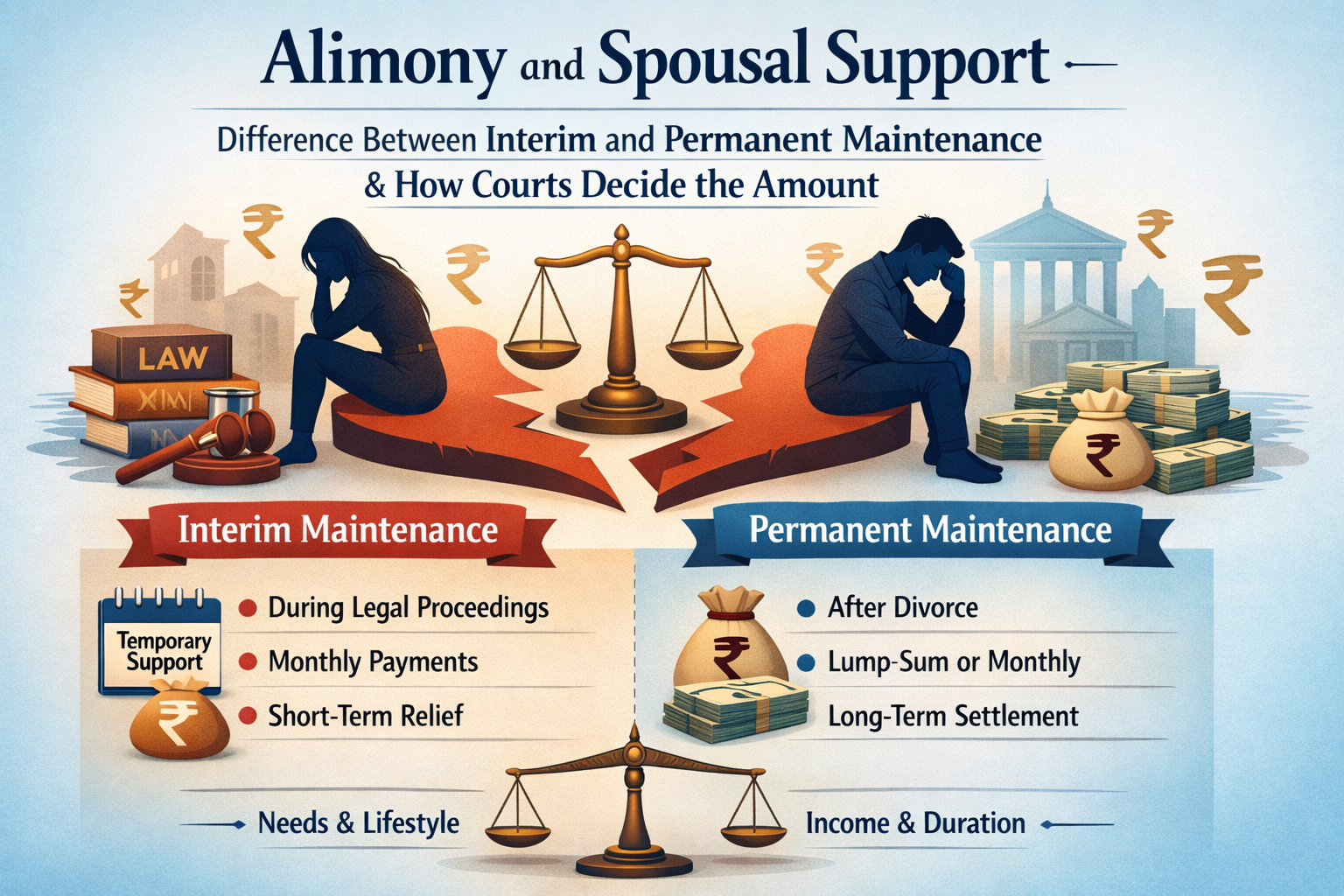
Alimony and Spousal Support — Difference Between Interim and Permanent Maintenance, and How Courts Decide the Amount
When a marriage breaks down, it’s not just the emotional bond that ends — often, one partner is left without financial security.
To ensure fairness and dignity after separation, Indian law provides for alimony and spousal maintenance, designed to prevent hardship and maintain balance between the two spouses.
This article explains the difference between interim and permanent maintenance, who can claim it, and how courts decide the amount.
1. The Purpose of Alimony and Spousal Support
Alimony or maintenance is not about punishing one spouse or rewarding another.
It is meant to ensure that the financially weaker spouse — whether husband or wife — can live with reasonable comfort and dignity after separation, similar to the standard of living they enjoyed during the marriage.
The law recognizes that marriage often involves economic interdependence — one spouse may have sacrificed a career or earnings to support the family, and such contributions deserve recognition when the marriage ends.
2. Legal Provisions Governing Alimony in India
Several laws provide for alimony or spousal maintenance:
- Section 24 of the Hindu Marriage Act, 1955 — Either spouse can seek interim maintenance (alimony pendente lite) during the pendency of any matrimonial case, if they have no independent income sufficient for support.
- Section 25 of the Hindu Marriage Act, 1955 — Provides for permanent alimony and maintenance at the time of divorce or thereafter.
- Section 125 of the Code of Criminal Procedure, 1973 (CrPC) — A secular provision that allows a dependent spouse to claim maintenance from the other, regardless of religion.
- Special Marriage Act, Parsi Marriage Act, Indian Divorce Act, and Muslim Women (Protection of Rights on Divorce) Act, 1986 — Contain similar provisions tailored to respective communities.
In essence, every spouse in India — regardless of gender or religion — has the right to seek financial support when genuinely in need.
3. Interim Maintenance (Alimony Pendente Lite)
Interim maintenance is temporary financial support granted during the pendency of divorce, restitution, or judicial separation proceedings.
Purpose:
To ensure that the dependent spouse has means to live, pay legal expenses, and maintain a reasonable lifestyle until the case concludes.
Key Features:
- Granted under Section 24 of the Hindu Marriage Act.
- Payable monthly or as a lump sum, depending on the court’s discretion.
- Covers day-to-day expenses like rent, food, clothing, travel, and basic medical costs.
- Usually decided within a few months of filing the application.
Example: If a wife is unemployed and the divorce case is ongoing, the court may direct the husband to pay ₹25,000 per month as interim maintenance until the case is decided.
4. Permanent Alimony (Final Maintenance)
Permanent alimony is granted once the marriage legally ends — either through divorce, judicial separation, or annulment.
It is a long-term financial arrangement meant to ensure the dependent spouse’s stability after marriage.
Key Features:
- Granted under Section 25 of the Hindu Marriage Act.
- Can be paid as a lump sum or periodic monthly payment.
- Amount and duration depend on multiple factors (explained below).
- Can be modified or cancelled later if there’s a significant change in circumstances (e.g., remarriage or financial improvement).
Example: After divorce, the husband may be ordered to pay a one-time amount of ₹10 lakh as permanent alimony, or ₹30,000 per month for 10 years.
5. Difference Between Interim and Permanent Maintenance
| Aspect | Interim Maintenance | Permanent Maintenance (Alimony) |
|---|---|---|
| When Granted | During case proceedings | After decree of divorce/separation |
| Duration | Temporary (until case ends) | Long-term or one-time |
| Purpose | To support spouse during litigation | To ensure post-divorce stability |
| Legal Section | Section 24, Hindu Marriage Act | Section 25, Hindu Marriage Act |
| Nature | Interim, modifiable easily | Final, but revisable if circumstances change |
| End Point | Ends with final judgment | Continues post-divorce (till remarriage/death or court modification) |
6. Factors Courts Consider While Deciding Alimony
There is no fixed formula in India — courts decide based on equity, fairness, and social context.
- Income and earning capacity of both spouses.
- Standard of living during marriage.
- Duration of marriage.
- Age and health of both parties.
- Educational qualifications and employability of the dependent spouse.
- Number of dependents (children, elderly parents, etc.).
- Conduct of the parties (though not punitive, cruelty/adultery may influence discretion).
- Financial obligations of the paying spouse.
Courts strive to ensure fairness — not equality — recognizing that both parties must be able to sustain themselves with dignity.
7. Landmark Judgments on Alimony
- Kalyan Dey Chowdhury v. Rita Dey Chowdhury (2017) — The Supreme Court suggested that 25% of the husband’s net monthly salary could serve as a reasonable benchmark for permanent alimony in some cases, though not a rigid rule.
- Rajnish v. Neha (2021) — The Supreme Court mandated mandatory income and asset affidavits for both parties to ensure transparency and consistency in maintenance awards.
- Smt. Vanamala v. H.M. Ranganatha Bhatta (1995) — Clarified that divorced spouses are entitled to claim permanent maintenance under Section 25 HMA.
- Chaturbhuj v. Sita Bai (2008) — Reaffirmed that even a capable but negligent spouse can be compelled to pay maintenance.
8. Can Husbands Claim Alimony?
Yes.
Indian law is gender-neutral in principle — if the husband can prove that he has no sufficient income and the wife earns substantially more, he can seek maintenance under Section 24 or 25 of the Hindu Marriage Act.
Courts have, in recent years, granted maintenance to unemployed or disabled husbands in genuine cases.
9. Modification and Termination of Alimony
Permanent alimony can be altered, suspended, or revoked if:
- The receiving spouse remarries, or
- Either spouse’s financial situation changes drastically, or
- There is misconduct or fraud in obtaining the order.
Courts retain continuing jurisdiction to ensure fairness over time.
10. Tax Treatment of Alimony
- Lump-sum alimony: Treated as a capital receipt, not taxable in the recipient’s hands.
- Monthly maintenance: Taxable as income to the receiver and deductible to the payer only in limited cases (depending on source and nature).
However, the Income Tax Act doesn’t expressly define this; parties should consult a tax expert for clarity.
11. Practical Tips for Spouses
For the Dependent Spouse:- File an application for interim relief early — don’t wait for financial hardship to worsen.
- Provide truthful details of expenses and needs.
- Keep receipts, proof of lifestyle, and documentation ready.
- Disclose your income honestly — courts value transparency.
- Avoid defaults; instead, seek modification if genuine financial constraints arise.
- Try to settle through mediation for a lump-sum closure if possible.
12. In Conclusion
Alimony is not revenge. It is a recognition of shared life, mutual dependence, and fairness after separation.
It ensures that one partner does not walk away into comfort while the other is left to struggle.
Ultimately, the court’s guiding question remains: “How can both parties move forward with dignity and stability, after the end of their marriage?”
The purpose of alimony is not to perpetuate dependence — it is to give the weaker spouse a foundation to rebuild life with self-respect.
“Alimony is not charity. It is the law’s way of ensuring fairness when love has ended.”