Call anytime
(+91) 98410 31719
Blog Details
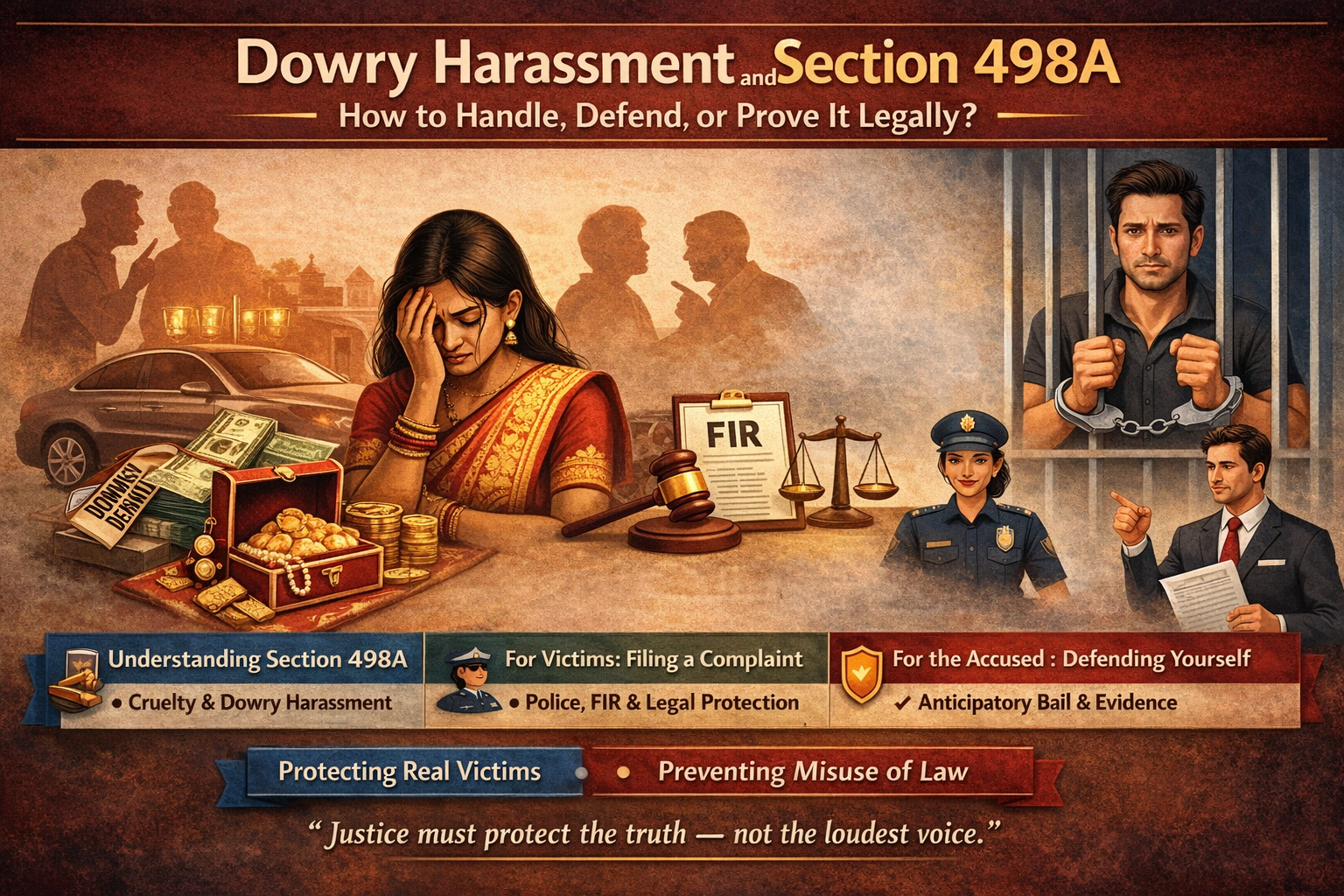
Dowry Harassment and Section 498A — How to Handle, Defend, or Prove It Legally ?
Dowry harassment cases under Section 498A of the Indian Penal Code represent one of the most painful intersections between law and emotion.
Introduced in 1983, this law was meant to protect women from cruelty, domestic abuse, and harassment in connection with dowry demands. But over time, misuse, exaggeration, and false cases have also surfaced — making it one of the most sensitive and contested provisions in Indian family law.
This article explains what Section 498A covers, how genuine victims can seek justice, and how falsely accused persons can defend themselves within the law.
1. Understanding Section 498A IPC
Section 498A of the Indian Penal Code reads as follows:
“Whoever, being the husband or the relative of the husband of a woman, subjects her to cruelty shall be punished with imprisonment for a term which may extend to three years and shall also be liable to fine.”
The term “cruelty” under this section includes:
- Any wilful conduct likely to drive a woman to suicide or cause grave injury (mental or physical), and
- Harassment with a view to coercing her or her relatives to meet unlawful demands for dowry.
It applies to husbands and their family members, and offences are non-bailable and cognizable.
2. Purpose of Section 498A
The purpose was never to punish families but to protect women from systemic abuse, financial coercion, and cruelty after marriage.
It was a response to the growing menace of dowry deaths and harassment that led many women to despair.
However, courts soon began receiving cases where the law was invoked maliciously — not as a shield, but as a weapon.
The challenge today is to preserve its purpose while preventing misuse.
3. Genuine Cases — When and How to File 498A
If a woman is genuinely facing cruelty, threats, or harassment linked to dowry or abuse, she has full legal protection.
She can initiate proceedings through the following steps:
Step 1: File a Police Complaint or FIR
Approach the nearest police station or the Women’s Police Cell.
Mention all facts, dates, incidents, and witnesses clearly.
If immediate danger exists, request police protection.
Step 2: Approach the Magistrate
The case is registered under Section 498A IPC and investigated.
Statements are recorded under Section 161 CrPC, and the charge sheet is filed before the magistrate.
Step 3: Parallel Remedies
- File a Domestic Violence case under the Protection of Women from Domestic Violence Act, 2005,
- Seek maintenance under Section 125 CrPC, and
- Initiate divorce on the ground of cruelty under Section 13(1)(ia) of the Hindu Marriage Act.
Courts encourage combining remedies to ensure protection and financial security.
4. Misuse of Section 498A — Judicial Concern
Indian courts have repeatedly expressed concern about the misuse of this law.
Key Observations:
Sushil Kumar Sharma v. Union of India (2005):
The Supreme Court acknowledged that although the law was constitutional, its misuse could not be ignored, describing it as “legal terrorism” in extreme cases.
Arnesh Kumar v. State of Bihar (2014):
The Supreme Court issued clear directions that arrest under 498A should not be automatic.
Police must first investigate and satisfy themselves that arrest is necessary.
Magistrates must also ensure due process before remanding accused to custody.
These judgments restored balance and fairness, ensuring that both genuine victims and innocent families are protected by due procedure.
5. If You Are a Victim — How to Prove Your Case
To establish cruelty or dowry harassment, the complainant must show:
- Specific incidents — not vague or generalized statements,
- Medical evidence (if physical harm occurred),
- Communication records — messages, emails, or witnesses showing demands or threats,
- Financial proof — transactions showing dowry or related pressure,
- Independent witnesses — friends, relatives, or neighbours who observed the conduct.
Consistency and credibility are crucial.
The complaint must narrate facts chronologically and clearly, avoiding exaggeration.
Courts prefer truthful, precise accounts over dramatic or sweeping allegations.
6. If You Are Falsely Accused — How to Defend Yourself
False or exaggerated cases can cause severe damage — but Indian law provides strong procedural safeguards and legal remedies to defend against them.
Step 1: Remain Calm and Cooperate
Do not panic or react aggressively. Avoid confrontation with the complainant.
Immediately consult a lawyer and prepare your response calmly.
Step 2: Apply for Anticipatory Bail
Under Section 438 CrPC, apply for anticipatory bail in the Sessions Court or High Court.
Since the Arnesh Kumar judgment, courts are cautious about unnecessary arrests in 498A cases.
Step 3: Collect Evidence of Innocence
Gather:
- Communication showing cordial relations or no dowry demand,
- Proof of financial independence of the wife,
- Travel records or witnesses disproving allegations,
- Bank or transaction evidence showing no illegal demand.
Step 4: Challenge the FIR (if frivolous)
You may approach the High Court under Section 482 CrPC to quash the FIR if it is:
- Malicious or exaggerated
- Filed after long delay, or
- Lacks factual details.
Courts regularly quash baseless 498A cases to prevent harassment of innocent families.
Step 5: Counter Action for Misuse
If the case is proven false, you can file: remedies such as defamation or compensation for mental cruelty may be pursued.
- Defamation (Sections 499–500 IPC), or
- Compensation claim for mental cruelty in civil court.
Courts have even allowed divorce on the ground of cruelty when false criminal allegations were made by one spouse.
7. Safeguards Introduced by Law and Courts
To curb misuse, several guidelines and measures exist:
- Arnesh Kumar (2014): No automatic arrests; police must justify arrests in writing.
- 2017 Supreme Court guidelines (Rajesh Sharma v. State of U.P.): Family Welfare Committees were initially suggested for pre-arrest scrutiny (later made optional).
- Judicial Review: Courts routinely discharge relatives when no specific role is alleged.
- Compounding and Mediation: Courts encourage settlement in non-serious cases through mediation.
These steps aim to protect both genuine victims and innocent families.
8. NRI Marriages and Section 498A
In NRI cases, if the offence occurred in India, the law still applies even if the husband resides abroad.
Look-out circulars and passport impoundment can occur.
However, NRIs falsely accused can:
- Seek anticipatory bail in India, and
- Request quashing or transfer to prevent abuse of process.
Courts ensure fair treatment for both parties across borders.
9. Difference Between Dowry Demand and Normal Gifts
Courts distinguish between customary gifts and dowry demands.
Dowry means a demand for money, property, or valuable security made as a condition of marriage.
Voluntary gifts given out of affection or tradition do not constitute dowry — unless linked to coercion or demand.
10. In Conclusion
Section 498A was never meant to divide families — it was meant to protect dignity and safety.
When applied honestly, it shields the oppressed. When misused, it erodes public faith in justice.
The law, therefore, walks a delicate balance — protecting victims while preventing misuse.
“Justice must protect the truth — not the loudest voice.”
Every case of dowry harassment deserves empathy, but also evidence.Whether you are a victim seeking justice or falsely accused seeking relief,
The right approach is not aggression, but lawful assertion.