Call anytime
(+91) 98410 31719
Blog Details
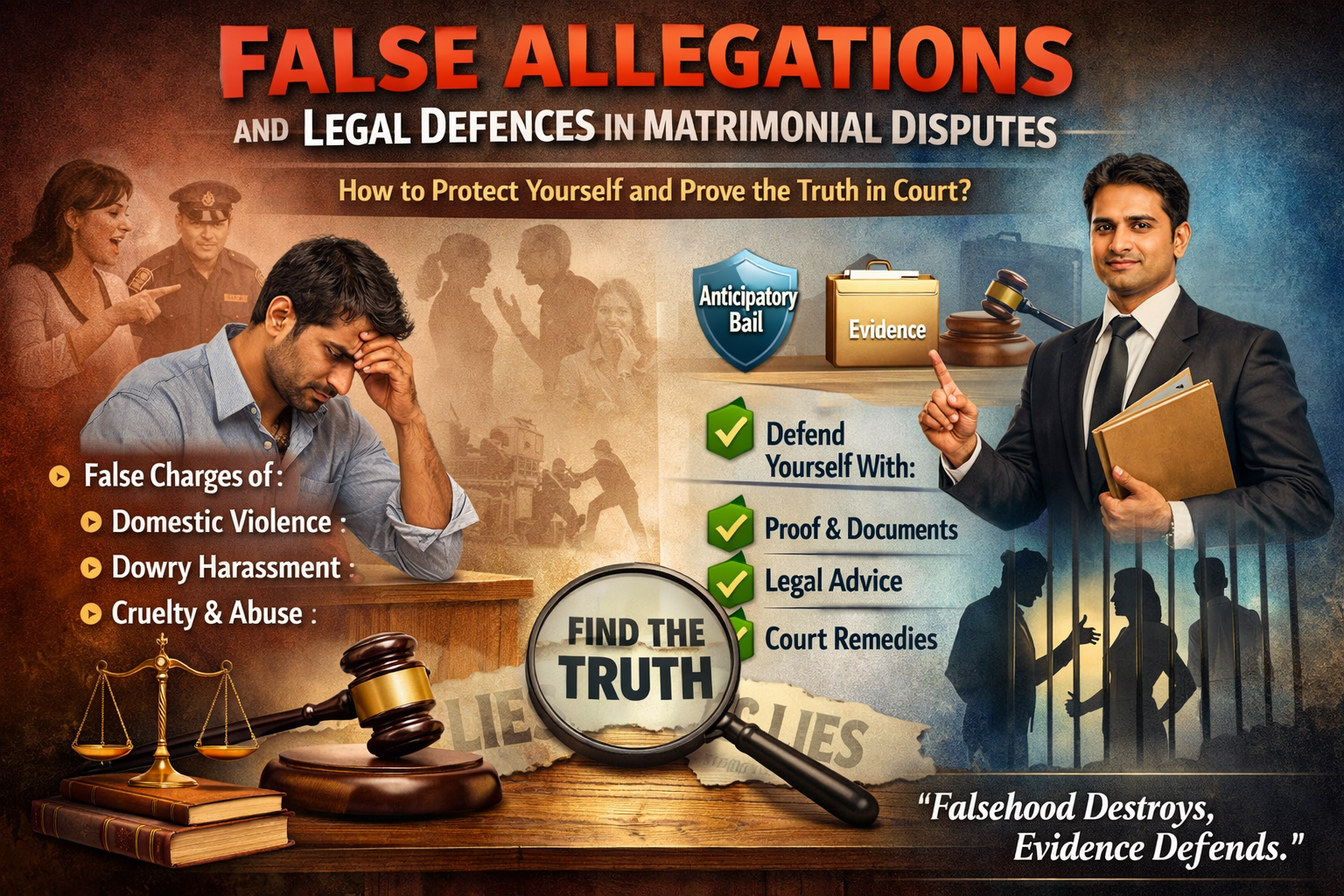
False Allegations and Legal Defences in Matrimonial Disputes — How to Protect Yourself and Prove the Truth in Court ?
Matrimonial disputes often begin with emotions — love, anger, betrayal — but once they reach the courtroom, allegations become evidence.
Unfortunately, some cases involve false or exaggerated claims — of cruelty, domestic violence, or dowry demand — made out of revenge, misunderstanding, or pressure. Such false accusations can destroy reputations, careers, and even families if not handled with care and legality.
The law protects genuine victims — but it equally protects those falsely accused, through proper defence, documentation, and judicial remedies.
This article explains how to recognize false allegations, how courts deal with them, and the strategic legal steps to defend yourself without fear or retaliation.
1. Understanding the Reality of False Allegations
False allegations in matrimonial cases can arise from:
- Personal vengeance or anger over separation,
- Influence of relatives or friends,
- Attempts to gain advantage in property, custody, or maintenance,
- Emotional instability or hurt ego, or
- Pressure tactics to force settlement.
Courts are aware that not every complaint reflects the truth, and that matrimonial litigation can be misused for emotional or financial leverage.
The goal of law is to separate genuine suffering from fabricated grievance — through evidence, consistency, and cross-examination.
2. Common Areas Where False Allegations Arise
Cruelty (Section 13(1)(ia), Hindu Marriage Act):
Alleging mental or physical cruelty without proof, often to claim sympathy or moral advantage.
Dowry Harassment (Section 498A IPC):
Misuse by filing exaggerated or fabricated dowry complaints after marital disputes.
Domestic Violence Act (Section 12, PWDVA, 2005):
Complaints made years after separation or with multiple family members named without role clarity.
Maintenance and Alimony:
False claims of unemployment or helplessness to secure high maintenance.
Custody Battles:
Accusations of neglect or abuse to weaken the other parent’s custody rights.
In each case, the law demands proof, not emotion. False accusations, when exposed, can themselves amount to mental cruelty, giving the innocent spouse the right to divorce.
3. Judicial View on False Allegations
Indian courts have repeatedly recognized that false allegations themselves constitute cruelty.
Vishwanath v. Sarla Vishwanath Agrawal (2012):
The Supreme Court held that making baseless allegations of extramarital affairs amounts to mental cruelty.
K. Srinivas Rao v. D.A. Deepa (2013):
Filing false criminal cases against a spouse and family members was held to be mental cruelty warranting divorce.
Raj Talreja v. Kavita Talreja (2017):
False accusations are not mere words; they destroy trust, cause mental agony, and justify divorce.
Preeti Gupta v. State of Jharkhand (2010):
The Supreme Court warned that misuse of dowry and domestic violence laws undermines genuine victims and burdens courts.
Thus, false allegations can legally backfire, turning the accused into the aggrieved party in the eyes of law.
4. How to Defend Yourself Against False Allegations
False allegations can be overwhelming, but a calm and structured response is key.
Step 1: Stay Calm and Avoid Retaliation
Never react impulsively or emotionally. Do not send angry messages, threats, or counter-allegations — they can be used against you. Let your defence be legal, not emotional.
Step 2: Engage a Competent Lawyer Immediately
An experienced family or criminal lawyer will analyse the allegations, advise on immediate protection (anticipatory bail, restraining order), and strategize a long-term defence plan covering both civil and criminal aspects.
Step 3: Secure Anticipatory Bail (if applicable)
If false criminal allegations under Section 498A IPC or Domestic Violence Act are filed, apply for anticipatory bail under Section 438 CrPC. Courts usually grant it if evidence of falsehood or non-violence exists.
Step 4: Collect and Preserve Evidence
- Messages, emails, or social media communication,
- Travel records, call logs, CCTV footage,
- Medical or financial documents disproving allegations,
- Witness statements from friends, neighbours, or colleagues.
Maintain a chronological diary of events — judges value clarity and consistency.
Step 5: File Counter-Proceedings Where Appropriate
- Defamation case (Sections 499–500 IPC) for false public accusations,
- Counter affidavit or written statement exposing inconsistencies,
- Petition for divorce on grounds of mental cruelty due to false accusations.
If the false complaint caused arrest or reputational harm, compensation petitions can also be considered.
Step 6: Approach High Court for Quashing (if justified)
Under Section 482 CrPC, you may approach the High Court to quash false criminal proceedings.
5. Role of Evidence in Proving Falsehood
Falsehood can only be defeated through proof.
- Contradictions between written complaint and testimony,
- Absence of corroboration (medical, police, or witness evidence),
- Delay in filing complaint without valid reason,
- Over-implication of family members,
- Forensic or digital evidence disproving presence or incident.
The standard of proof is civil (preponderance of probability) in matrimonial cases — meaning the court decides based on which side appears more credible.
6. Avoiding Common Mistakes
- Remaining passive, assuming truth will prevail automatically,
- Responding emotionally through social media or direct contact,
- Ignoring summons or non-cooperating with investigation,
- Failing to file proper written counter or documentary evidence.
Remember, silence can look like guilt in court. Always respond formally and timely.
7. Protection for Family Members
False complaints often drag parents, siblings, and relatives into litigation. Courts have repeatedly criticized this misuse.
In K. Subba Rao v. State of Telangana (2018), the Supreme Court observed that casually implicating all relatives without specific allegations is abuse of process.
Such relatives can seek quashing under Section 482 CrPC or file for discharge before the trial court, showing lack of role or evidence.
8. How Courts View Reconciliation After False Allegations
If false allegations were made but later withdrawn, courts assess whether reconciliation is realistic.
In most cases, continued cohabitation after serious false charges becomes impossible — courts treat it as a complete breakdown of trust.
9. Guidance for Genuine Complainants
While this article focuses on false cases, genuine victims should never feel discouraged. The law exists to protect them.
But truth must always be supported by evidence — real victims stand stronger when the system is not burdened by misuse.
10. In Conclusion
False allegations are like fire — they can destroy both the innocent and the accuser if not handled wisely.
The best defence is calm truth, legal discipline, and documentary proof.
The law in India is now mature — it distinguishes between real pain and manufactured complaint.
“Truth may be delayed in court, but it is never defeated.”
In matrimonial law, justice is not about who speaks louder — it’s about who proves sincerely.
“Falsehood can momentarily win sympathy, but truth alone wins judgment.”