Call anytime
(+91) 98410 31719
Blog Details
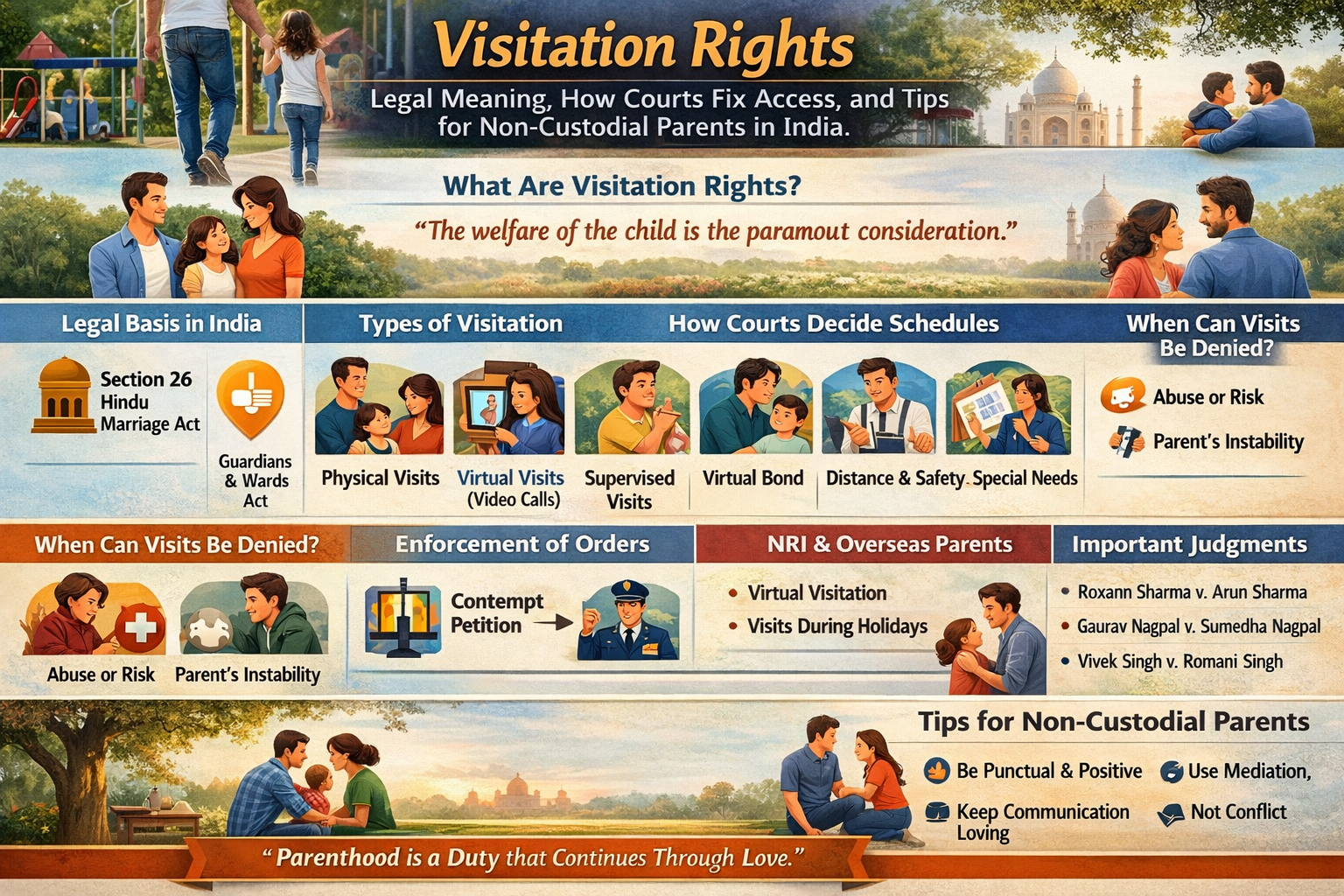
Visitation Rights — Legal Meaning, How Courts Fix Access, and Tips for Non-Custodial Parents in India
In every custody battle, one parent may win the right to keep the child — but the other parent does not lose parenthood.
The court recognizes that even after divorce or separation, a child has an equal right to the love, care, and presence of both parents.
That continuing bond is protected through visitation rights — a legal mechanism that ensures the non-custodial parent remains an active and meaningful part of the child’s life.
1. What Are Visitation Rights?
Visitation rights refer to the legally recognized right of the parent who does not have custody (usually the father, sometimes the mother) to meet, interact, and spend time with the child.
It flows from the same principle that guides all custody laws in India:
“The welfare of the child is the paramount consideration.”
Visitation is not a favour or privilege; it is part of the child’s fundamental right to have both parents in their life — unless there are strong reasons to restrict it.
2. Legal Basis of Visitation Rights in India
Visitation rights are derived from:
- Section 26 of the Hindu Marriage Act, 1955 – empowers Family Courts to make provisions for child custody, maintenance, and access.
- Guardians and Wards Act, 1890 (Section 12 & 25) – allows courts to regulate guardianship and visitation during and after proceedings.
- Personal laws of other communities, which also place welfare above all.
Even if the court grants permanent custody to one parent, it usually provides visitation rights to the other, unless exceptional circumstances (like abuse, neglect, or risk) justify denial.
3. The Purpose Behind Visitation Rights
Visitation exists to:
- Preserve the emotional relationship between the child and the non-custodial parent.
- Protect the child from alienation or manipulation.
- Ensure balanced parenting and emotional security.
- Reinforce that divorce ends marriage, not parenthood.
Courts recognize that complete severance from one parent can emotionally damage a child, creating long-term psychological distress.
4. Types of Visitation Rights
Courts in India grant different forms of visitation based on the child’s age, school schedule, and the parents’ relationship.
A. Physical Visitation
The parent can meet and spend time with the child in person. This may be:
- Short meetings: Few hours weekly or bi-weekly.
- Extended access: Overnight or weekend stays.
- Holiday access: During vacations, birthdays, or festivals.
B. Virtual Visitation
In NRI or long-distance cases, courts allow interaction through:
- Video calls,
- Online platforms (Zoom, WhatsApp, etc.), and
- Regular phone calls or digital communication.
This ensures contact despite geographical barriers.
C. Supervised Visitation
If there is tension, fear, or risk of influence, the court may direct that visits occur in the presence of a neutral third person — often a relative, mediator, or within the court premises.
D. Flexible Visitation
In amicable cases, courts allow parents to mutually decide visitation schedules without strict timelines — encouraging trust and co-parenting.
5. How Courts Fix Visitation Schedules
There is no one-size-fits-all formula. Courts tailor visitation rights to the child’s welfare, comfort, and convenience. Factors considered include:
- Child’s age and schooling — Younger children may need shorter, frequent visits; older ones can handle longer stays.
- Emotional bond with each parent.
- Distance between parental residences.
- Parental behaviour and cooperation level.
- Special circumstances — like NRI parents, safety concerns, or health conditions.
Courts aim for regular and meaningful contact — not token access. Typical examples include:
- Weekly or alternate weekend visits.
- Overnight stays once or twice a month.
- Shared holidays or birthdays.
- Video calls on school days.
The court may adjust the arrangement as the child grows or circumstances change.
6. Child’s Wishes and Comfort
As per Indian judicial practice, if the child is old enough (usually above 9–10 years) and mature to express a preference, the court may consider their views.
However, the child’s opinion is not final — the court balances it with overall welfare.
If a child refuses visitation due to fear or manipulation, the court may order counselling or gradual reintroduction sessions to rebuild trust.
7. When Visitation Can Be Denied or Restricted
Courts rarely deny visitation altogether, but they may restrict or suspend it if:
- The parent poses a threat to the child’s safety,
- Has a history of abuse, addiction, or instability,
- Tries to influence or alienate the child, or
- Fails to respect previous court directions.
Such restrictions are always temporary — subject to review upon behavioural improvement.
8. Enforcement of Visitation Orders
Visitation orders are legally binding.
If the custodial parent repeatedly obstructs access:
- The non-custodial parent can file an execution petition or contempt application before the Family Court.
- The court may issue directions, fines, or police assistance to enforce compliance.
- Persistent defiance can also affect the custodial parent’s credibility in future custody reviews.
However, courts prefer persuasion, counselling, and mediation before coercive action — keeping the child’s peace as the priority.
9. Visitation Rights for NRI Parents
For NRIs or parents living abroad, Indian courts often:
- Allow virtual visitation (video calls, scheduled online meetings).
- Permit physical visitation during visits to India (summer/winter holidays).
- Mention in the order that the custodial parent must cooperate for visa or travel paperwork.
If both parents live abroad but the child is in India, the court can authorize a trusted relative to facilitate access or represent the parent in custody-related matters.
10. Important Judgments
- Roxann Sharma v. Arun Sharma (2015) – Reaffirmed that visitation rights are integral to custody and must ensure consistent contact with both parents.
- Gaurav Nagpal v. Sumedha Nagpal (2009) – Welfare of the child is paramount; courts must design visitation to preserve emotional stability.
- Vivek Singh v. Romani Singh (2017) – Denying visitation can amount to mental cruelty and harm the child’s well-being.
- Nithya Anand Raghavan v. State (NCT of Delhi) (2017) – In NRI cases, visitation should prioritize the child’s security within India.
11. Tips for Non-Custodial Parents
- Always focus on the child’s comfort, not your grievance.
- Be punctual, patient, and positive during visits.
- Never speak negatively about the other parent before the child.
- Avoid litigation aggression — use mediation where possible.
- Keep communication with the child consistent and loving, even if access is limited.
- If abroad, request video access rights and ensure time zone-friendly schedules.
- Respect boundaries and court timings — it builds long-term trust.
Visitation is not about asserting authority — it’s about showing reliability and love.
12. In Conclusion
Visitation rights bridge the emotional gap that divorce can create between a parent and a child.
They ensure that while marriages may end, the child’s world does not collapse.
In the eyes of law and humanity alike:
“Parenthood is not a right that ends with divorce — it is a duty that continues through love.”
When both parents cooperate to make visitation work, the child learns that even separation can coexist with stability, affection, and peace.