Call anytime
(+91) 98410 31719
Blog
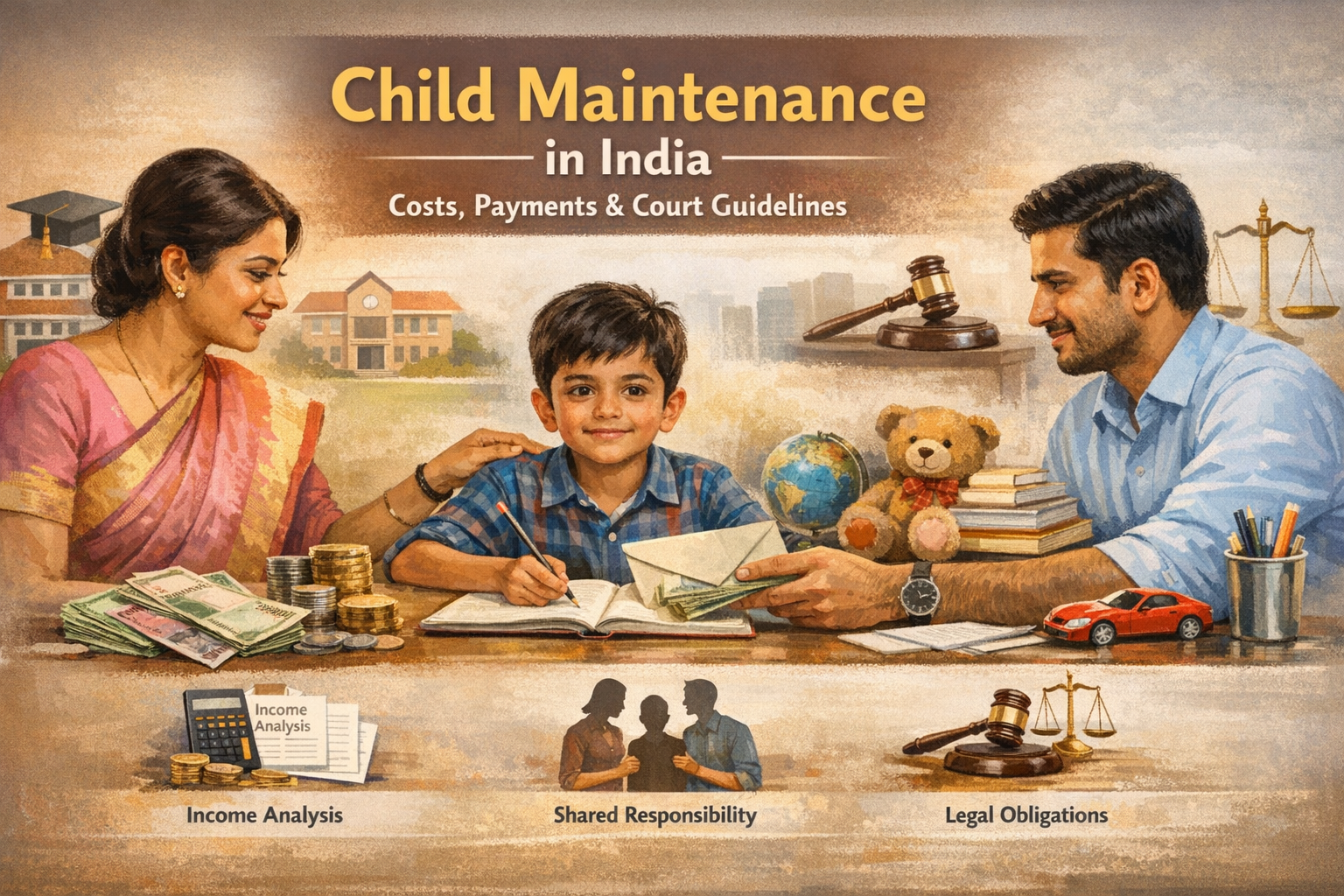
Child Maintenance — How It Is Calculated, Who Pays, and Key Court Guidelines in India
When a marriage ends, parental responsibility does not. Regardless of where a child lives — with the mother or father — both parents remain equally responsible for the child’s upbringing, education, and well-being.
To ensure that a child does not suffer financially due to the separation, Indian law provides for child maintenance — a legal obligation of one parent to contribute financially to the child’s care and development.
This article explains who pays child maintenance, how courts calculate it, and what factors determine the amount under Indian law.
1. What Is Child Maintenance?
Child maintenance is the financial support paid by one parent to the other for the child’s daily needs — food, clothing, shelter, education, healthcare, and overall upbringing.
It is not a favour or gift but a legal duty arising out of parenthood. Even if a parent has lost custody, their obligation to support the child continues until the child becomes an adult — and in some cases, beyond that.
2. Legal Provisions Governing Child Maintenance
Several laws in India provide for child maintenance:
- Section 125 of the Code of Criminal Procedure, 1973 (CrPC): A secular and speedy remedy applicable to all communities. It allows a parent or guardian to seek maintenance for a minor child from the parent who has sufficient means but neglects or refuses to maintain.
- Section 20 of the Hindu Adoptions and Maintenance Act, 1956 (HAMA): A Hindu father or mother is bound to maintain their legitimate or illegitimate children during minority and, in certain cases, even after attaining majority if the child is unable to maintain themselves.
- Section 26 of the Hindu Marriage Act, 1955: During matrimonial proceedings (like divorce or judicial separation), the court can make temporary or permanent orders for the maintenance and education of minor children.
- Guardians and Wards Act, 1890: The court can direct maintenance as part of custody or guardianship orders.
Together, these ensure that a child’s welfare is never compromised, regardless of the parents’ personal disputes.
3. Who Can Claim Child Maintenance?
Child maintenance can be claimed by:
- The custodial parent on behalf of the minor child, or
- The child directly (through a guardian or next friend) if capable of understanding the proceedings.
Even if the custodial parent is financially independent, the non-custodial parent (usually the father) is still legally bound to contribute proportionately to the child’s needs.
4. Who Has to Pay?
Typically, the parent not having custody pays maintenance to the parent who has custody.
However, this depends on the income and means of both parents.
- If the father is well-employed and the mother is unemployed or earns less, he will be directed to pay.
- If the mother earns substantially more, courts may reduce or even deny maintenance to prevent unfair enrichment.
- In rare cases, if the father has no income and the mother is financially stable, the court can order the mother to pay.
The law is gender-neutral — the paramount factor is the child’s welfare, not parental status.
5. Duration of Child Maintenance
- Until the child attains majority (18 years).
- If the child is physically or mentally challenged, or unable to support themselves, maintenance can continue beyond 18 years.
- For female children, courts sometimes direct maintenance till marriage, especially for education or safety reasons.
6. How Courts Calculate the Amount
There is no fixed formula, but courts follow broad principles developed through judgments.
The objective is to maintain the child’s standard of living similar to what they enjoyed during the parents’ marriage.
Courts consider:
- Income and earning capacity of both parents.
- Number of dependents (other children, elderly parents, etc.).
- Education expenses (school fees, tuition, extracurriculars).
- Medical and housing costs.
- Lifestyle and social background of the family.
- Inflation and cost of living in the city.
The idea is balance — neither parent should live luxuriously while the child suffers, nor should the paying parent be left destitute.
7. Landmark Judicial Guidelines
Several Supreme Court and High Court judgments have helped standardize the approach:
- Rajnish v. Neha (2021) — The Supreme Court laid down a detailed framework for maintenance claims, including disclosure of income, assets, and liabilities by both parties through affidavits. The judgment emphasized transparency and uniformity.
- Gaurav Nagpal v. Sumedha Nagpal (2009) — Welfare of the child is of paramount importance; both parents share financial responsibility.
- Vinny Parmvir Parmar v. Parmvir Parmar (2011) — Maintenance should reflect the standard of living enjoyed by the child before separation.
- Chaturbhuj v. Sita Bai (2008) — Even capable parents who neglect to support their child can be compelled to pay maintenance, irrespective of formal employment.
8. Interim Maintenance
Pending final orders, courts may grant interim child maintenance to meet immediate needs such as school fees, medical expenses, or basic sustenance.
This ensures that the child’s welfare is not delayed by procedural timelines.
9. Can Maintenance Be Increased or Decreased Later?
Yes. Maintenance is not static — it can be modified if there’s a change in circumstances, such as:
- Change in either parent’s income,
- Inflation,
- Medical or educational needs of the child,
- Remarriage or relocation.
A fresh application can be filed before the same court for enhancement or reduction of the amount.
10. Non-Payment of Child Maintenance
If a parent fails to comply with a maintenance order:
- The custodial parent can file an execution petition in Family Court.
- The court can order attachment of salary or property of the defaulting parent.
- Persistent non-payment may even result in civil imprisonment under Section 125(3) CrPC.
Courts take non-payment seriously, as it directly affects the child’s welfare.
11. Child Maintenance in NRI Cases
For NRI parents, child maintenance orders passed by Indian courts are enforceable if:
- The parent has assets or income in India, or
- The decree is recognized by a foreign court under reciprocal arrangement treaties.
If the child lives abroad, the Indian court still retains jurisdiction if the marriage was solemnized or domiciled in India. Many NRI fathers have been directed to send maintenance electronically, ensuring timely financial support.
12. Practical Tips for Parents
For the Custodial Parent:
- Maintain all receipts and records of the child’s expenses.
- Avoid exaggeration — courts value transparency.
- Focus on the child’s actual needs, not revenge or comparison.
For the Paying Parent:
- Never delay payments — it weakens your credibility.
- Keep proof of all payments (bank transfers, receipts).
- If income changes, promptly seek modification rather than defaulting.
For Both:
- Remember that maintenance is about the child’s comfort and dignity, not competition between parents.
- Cooperation, not conflict, ensures the child’s emotional stability.
13. In Conclusion
Child maintenance is not merely a financial duty — it is an expression of continued parenthood. The court’s role is to ensure that a child’s innocence and future remain untouched by the bitterness of separation.
In every case, the underlying message of the law is simple yet profound:
“A child should never suffer for the choices of adults.”
Providing for your child, even after divorce, is not charity — it is love, carried forward through responsibility.