Call anytime
(+91) 98410 31719
Blog Details
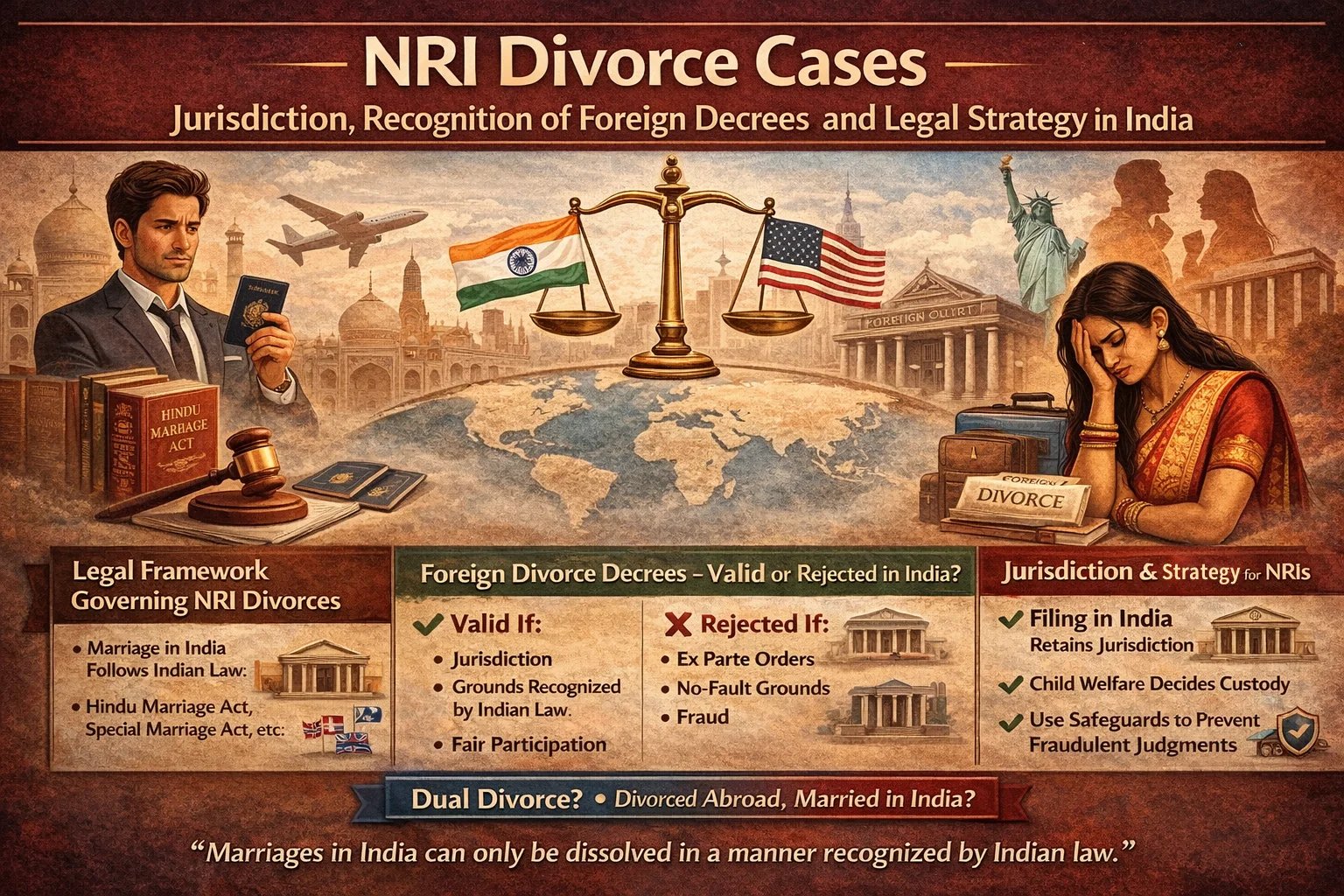
NRI Divorce Cases — Jurisdiction, Recognition of Foreign Decrees, and Legal Strategy in India
Marriages today often cross borders — an Indian citizen marrying an NRI, or two Indians settling abroad after marriage.
But when the relationship breaks down, the question of where to file for divorce and which court’s judgment is valid becomes complicated.
Indian law still governs the marriage, but foreign jurisdictions may also claim authority — leading to conflicting decrees, overlapping cases, and immense emotional and legal confusion.
This article explains how Indian courts handle NRI divorces, when foreign decrees are recognized or rejected, and the strategic legal steps for spouses facing international matrimonial disputes.
1. Legal Framework Governing NRI Divorces
The starting point is clear:
If the marriage was solemnized in India — under Hindu Marriage Act, Special Marriage Act, Christian, or Muslim law — it remains governed by Indian matrimonial law, regardless of where the couple currently resides.
Thus, the Hindu Marriage Act, 1955, and the Special Marriage Act, 1954, continue to apply to Hindus and inter-faith marriages respectively, even if the couple lives abroad.
However, foreign courts may also exercise jurisdiction based on residency or domicile.
This duality often leads to disputes about whether an overseas divorce is valid in India.
2. When a Divorce Decree Passed Abroad Is Valid in India
Indian courts recognize foreign divorce decrees only under certain conditions, governed by Section 13 of the Code of Civil Procedure, 1908 (CPC).
For a foreign divorce to be valid and binding in India, it must satisfy these conditions:
✅ (a) Jurisdiction
The foreign court must have had proper jurisdiction — meaning, both spouses were domiciled or ordinarily resident in that country at the time of filing.
✅ (b) On Merits
The judgment must be based on grounds recognized under Indian law, and not merely on default or absence of appearance.
✅ (c) Participation
The spouse against whom divorce was granted must have had a fair opportunity to contest — meaning they were duly served and either appeared or had representation.
✅ (d) No Violation of Indian Law or Public Policy
The decree must not violate Indian morality, natural justice, or public policy.
For instance, “irretrievable breakdown of marriage” is not a recognized ground for divorce under current Hindu Marriage Act — so an ex parte foreign decree based on that ground may not be valid in India.
3. When a Foreign Divorce Decree Is Not Recognized
A foreign divorce decree will be rejected by Indian courts if:
1. It was obtained ex parte (without the other spouse’s participation).
2. It was granted on grounds not available under Indian law (e.g., “no-fault divorce”).
3. The foreign court lacked jurisdiction over the marriage.
4. It was obtained through fraud or misrepresentation.
Key Judgments:
Y. Narasimha Rao v. Y. Venkata Lakshmi (1991)
The Supreme Court held that a foreign divorce decree is not valid in India unless both parties submitted to the foreign court’s jurisdiction and the ground of divorce is recognized under Indian law.
Satya v. Teja Singh (1975)
The Court refused to recognize a Nevada (U.S.) divorce obtained without the wife’s participation, holding that Indian marriages cannot be dissolved by foreign judgments unilaterally.
These precedents remain the foundation of how Indian courts assess the validity of NRI divorces.
4. Jurisdiction — Where Should You File Divorce in NRI Marriages?
If the marriage was solemnized in India, the Family Court in India retains jurisdiction under:
- Section 19 of the Hindu Marriage Act, or
- Section 31 of the Special Marriage Act.
A spouse residing abroad can be served notice through:
- Indian consulates,
- Registered international post, or
- e-mail service, as recognized by courts in digital proceedings.
Thus, Indian courts remain competent to handle NRI divorces even if one party is overseas.
5. What If the Divorce Is Already Filed Abroad?
If one spouse has already filed a divorce case in a foreign court, the other spouse can:
- File an objection in the foreign court contesting jurisdiction, or
- File a parallel divorce or injunction petition in India to restrain further foreign proceedings.
Indian courts may pass an anti-suit injunction if it is proven that the foreign proceedings are oppressive, unfair, or meant to defeat Indian jurisdiction.
6. Recognition and Enforcement of Foreign Decrees
If the foreign divorce decree satisfies Section 13 CPC requirements, it can be enforced in India by filing:
- An execution petition, or
- A declaration suit seeking its recognition.
However, if the decree fails these tests, it is treated as non est (invalid) — and the marriage continues to subsist in the eyes of Indian law.
7. Child Custody in NRI Marriages
Child custody is one of the most emotionally complex aspects of NRI divorces.
Even if a foreign court grants custody to one parent, Indian courts do not automatically enforce it.
The Supreme Court in Nithya Anand Raghavan v. State (2017) held that:
“The welfare of the child is paramount, not the jurisdiction of the foreign court.”
Thus, custody disputes are decided independently by Indian courts, focusing on the child’s welfare, not parental convenience.
8. Maintenance and Alimony in NRI Divorces
Maintenance under:
- Section 125 CrPC,
- Section 24 or 25 HMA, or
- Protection of Women from Domestic Violence Act, 2005,
can be claimed in India, even if a divorce is pending abroad.
If the spouse earning abroad fails to pay, Indian courts can:
If the spouse earning abroad fails to pay, Indian courts can:
- Attach assets in India, or
- Request cooperation through reciprocal treaty arrangements with countries like the U.S., U.K., Canada, and Australia.
9. Practical Legal Strategy for NRIs and Indian Spouses
For the Indian Spouse (usually residing in India):
- File divorce or maintenance in India first — to secure jurisdiction.
- Avoid ignoring foreign notices — participate through a lawyer abroad to prevent ex parte orders.
- Preserve all documents proving residence and marriage in India.
For the NRI Spouse:
- File in India only if genuinely connected (marriage place, last residence, etc.).
- If filing abroad, ensure the other spouse participates voluntarily.
- Avoid unilateral decrees — they will not be valid in India.
- If falsely accused, apply for case transfer or quashing of FIRs filed in India.
10. The Concept of “Dual Divorce”
It is common for one spouse to obtain divorce abroad while the other continues litigation in India.
This results in dual marital status — divorced abroad but married in India.
To avoid this, it’s essential that both parties either:
- Mutually agree to recognize the foreign jurisdiction, or
- Complete a parallel legal closure in India to avoid future disputes in property, remarriage, or child custody.
11. In Conclusion
Cross-border marriages test not just emotional endurance but also the boundaries of legal systems.
Indian courts maintain a simple principle:
“A marriage solemnized in India can only be dissolved in a manner recognized by Indian law.”
Foreign divorces obtained fairly and on valid grounds are respected — but fraudulent, ex parte, or one-sided decrees hold no value here.
The key to success in NRI divorce cases lies in strategy, jurisdictional clarity, and timely legal action.
“Law travels across borders, but justice follows the truth.”