Call anytime
(+91) 98410 31719
Blog Details
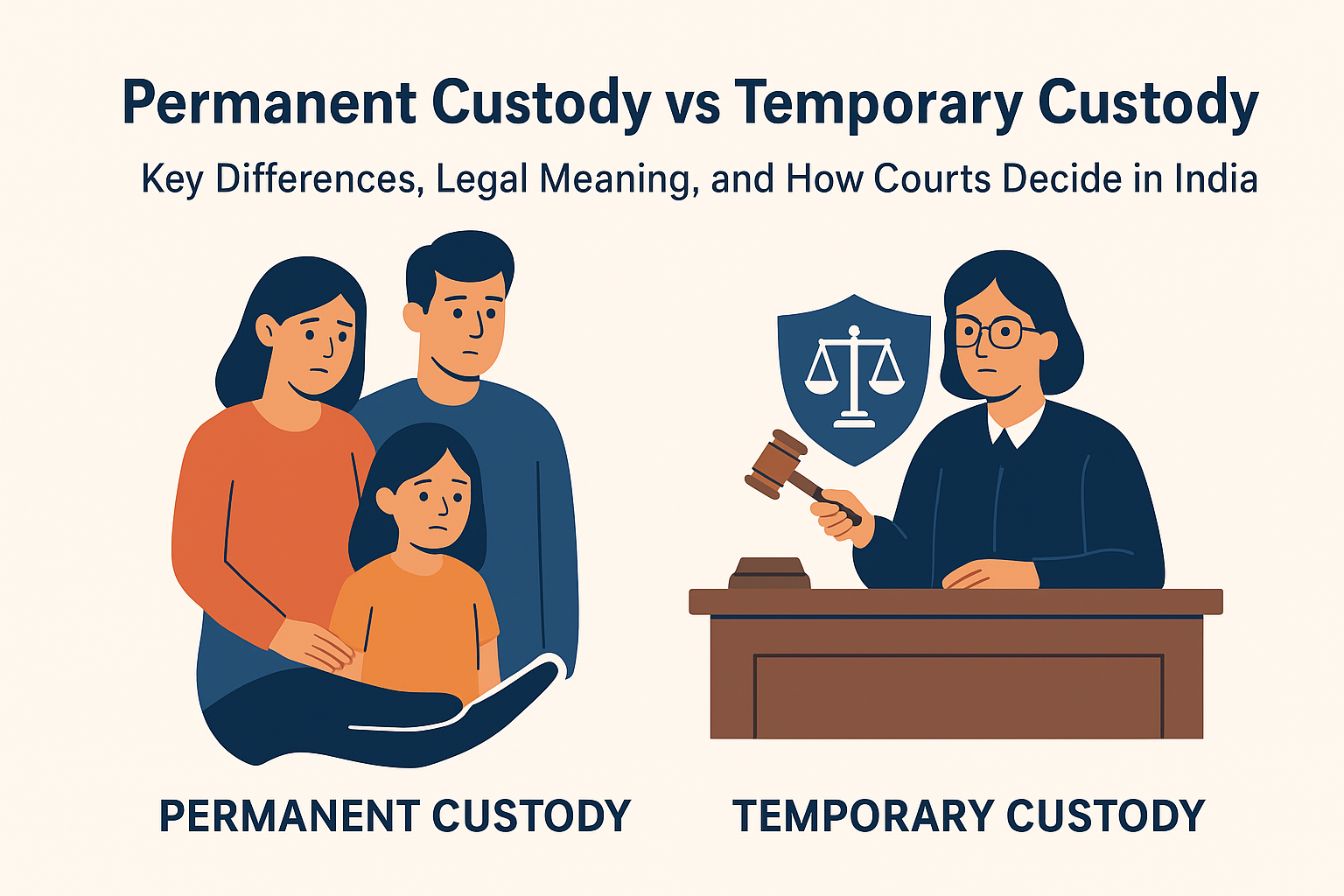
Permanent Custody vs. Temporary Custody — Key Differences, Legal Meaning, and How Courts Decide in India
Child custody is one of the most sensitive aspects of any divorce or separation case. Parents often hear terms like “interim custody,” “temporary custody,” and “permanent custody” in Family Court proceedings — yet very few fully understand what they legally mean.
In India, the difference between temporary custody and permanent custody lies not only in time but also in purpose, stability, and finality. This article explains what each term means, how the courts decide custody duration and conditions, and why the phrase “permanent custody” has special importance — especially in documentation for schools, passports, and foreign travel.
1. Legal Basis for Custody in India
Custody issues are primarily governed by:
- Section 26 of the Hindu Marriage Act, 1955 — for custody during or after matrimonial proceedings.
- Guardians and Wards Act, 1890 — a secular law that applies to all, including non-Hindus and NRIs.
Both these laws empower courts to:
- Grant custody (temporary or permanent),
- Modify custody orders if circumstances change, and
- Ensure that the welfare of the child is always the central consideration.
2. What Is Temporary (Interim) Custody?
Temporary custody — also known as interim custody — is granted for a limited duration, usually during the pendency of divorce, maintenance, or guardianship proceedings.
Purpose:
- To ensure that the child is cared for, educated, and emotionally secure while the case is still ongoing.
- To provide a stable arrangement until the court makes a final decision.
Key Features:
- Duration: Valid only until the final judgment or further court order.
- Flexibility: Can be modified quickly if new circumstances arise (for example, school relocation, medical needs, or misconduct by the custodial parent).
- Non-final: Does not decide who will ultimately have full custody — it is only provisional.
Example:
If a divorce case is ongoing and the child is living with the mother, the court may pass an interim custody order granting her temporary custody with weekend visitation for the father. Once the case concludes, a final or permanent custody order replaces it.
3. What Is Permanent Custody?
Permanent custody (sometimes referred to as “final custody”) is the final judicial determination of who will have the long-term responsibility to raise and care for the child after the conclusion of all proceedings.
Purpose:
- To ensure the child’s future stability, welfare, and upbringing under a settled arrangement.
Key Features:
- Duration: Continues until the child attains majority (18 years), unless changed by subsequent court order.
- Finality: Granted after detailed consideration of evidence, counselling reports, and the child’s welfare.
- Comprehensiveness: Covers education, residence, healthcare, moral upbringing, and overall supervision.
- Legally recognized: Essential for schools, passport offices, visa/embassy requirements, and government records.
4. The Core Difference — Purpose and Permanence
Aspect
Temporary (Interim) Custody
Permanent Custody
Purpose: Provisional arrangement during case
Final custody after case conclusion
Duration: Until modified or final decree
Until child attains 18 years
Nature: Temporary, flexible
Stable, legally binding
Granted by: Family Court (interim stage)
Family Court (final judgment)
Can be changed? Easily, based on new facts
Only by fresh court order or appeal
Use for official purposes: Not accepted by embassies/schools
Required for official/legal recognition
5. How Courts Decide Permanent Custody
Permanent custody is never granted based on ownership or gender — it is based entirely on the welfare and best interests of the child.
Courts examine:
- Age and needs of the child — very young children are usually placed with the mother.
- Parental stability — financial, emotional, and social.
- Child’s comfort, education, and environment.
- Parental conduct and ability to provide care.
- Willingness to ensure access to the other parent.
The Supreme Court and High Courts have repeatedly emphasized that custody is not a matter of parental rights but of child welfare — the child’s happiness, safety, and future take absolute priority.
6. The Role of Visitation Rights
When one parent receives permanent custody, the other parent usually receives visitation rights — either:
- Physical visits (weekends, holidays), or
- Virtual visits (video calls, especially in NRI or intercity cases).
7. Modification of Permanent Custody
Even “permanent custody” is not truly irreversible.
If circumstances change — for example:
- The custodial parent remarries and relocates abroad,
- Develops health or addiction issues, or
- The child’s welfare is compromised —
The other parent can file a fresh petition under Section 25 of the Guardians and Wards Act seeking modification of custody.
Courts have the continuing power to review and revise custody orders whenever required to protect the child.
8. Importance of “Permanent Custody” in Official Documents
While courts sometimes use the word “custody” generally in their judgments, the term “permanent custody” carries critical significance for practical and legal reasons:
- Embassies and consulates (especially for visa or passport purposes) require explicit mention of permanent custody.
- Schools and government departments often insist on a “permanent custody” decree before transferring a minor or processing parental authorizations.
- NRIs seeking dependent visas or travel documentation for children need this phrasing to satisfy foreign authorities.
Thus, lawyers must ensure that final decrees use clear language like:
“The petitioner is granted permanent custody of the minor child until the child attains the age of majority.”
This eliminates ambiguity and prevents future administrative difficulties.
9. Case Law Insights
Gaurav Nagpal v. Sumedha Nagpal (2009): Welfare of the child is the paramount consideration.
Roxann Sharma v. Arun Sharma (2015): Custody of children below five years generally with the mother.
Vivek Singh v. Romani Singh (2017): Emotional well-being of the child outweighs all other considerations.
Nithya Anand Raghavan v. State (NCT of Delhi) (2017): Foreign orders are secondary to the welfare of the child residing in India.
10. Practical Tips for Parents
- Always put the child’s comfort and routine above personal differences.
- Record all settlement terms related to custody clearly in the final decree.
- Avoid using the word “custody” loosely — specify whether it’s interim or permanent.
- Ensure visitation rights are practical and not punitive.
- For NRIs, request clear wording on international travel and decision-making rights.
11. In Conclusion
The difference between temporary and permanent custody is the difference between now and always. Temporary custody protects the child during uncertainty. Permanent custody secures the child’s future once the storm has passed.
“A child’s happiness is permanent only when both parents act in love, even if apart in life.”