Call anytime
(+91) 98410 31719
Blog Details
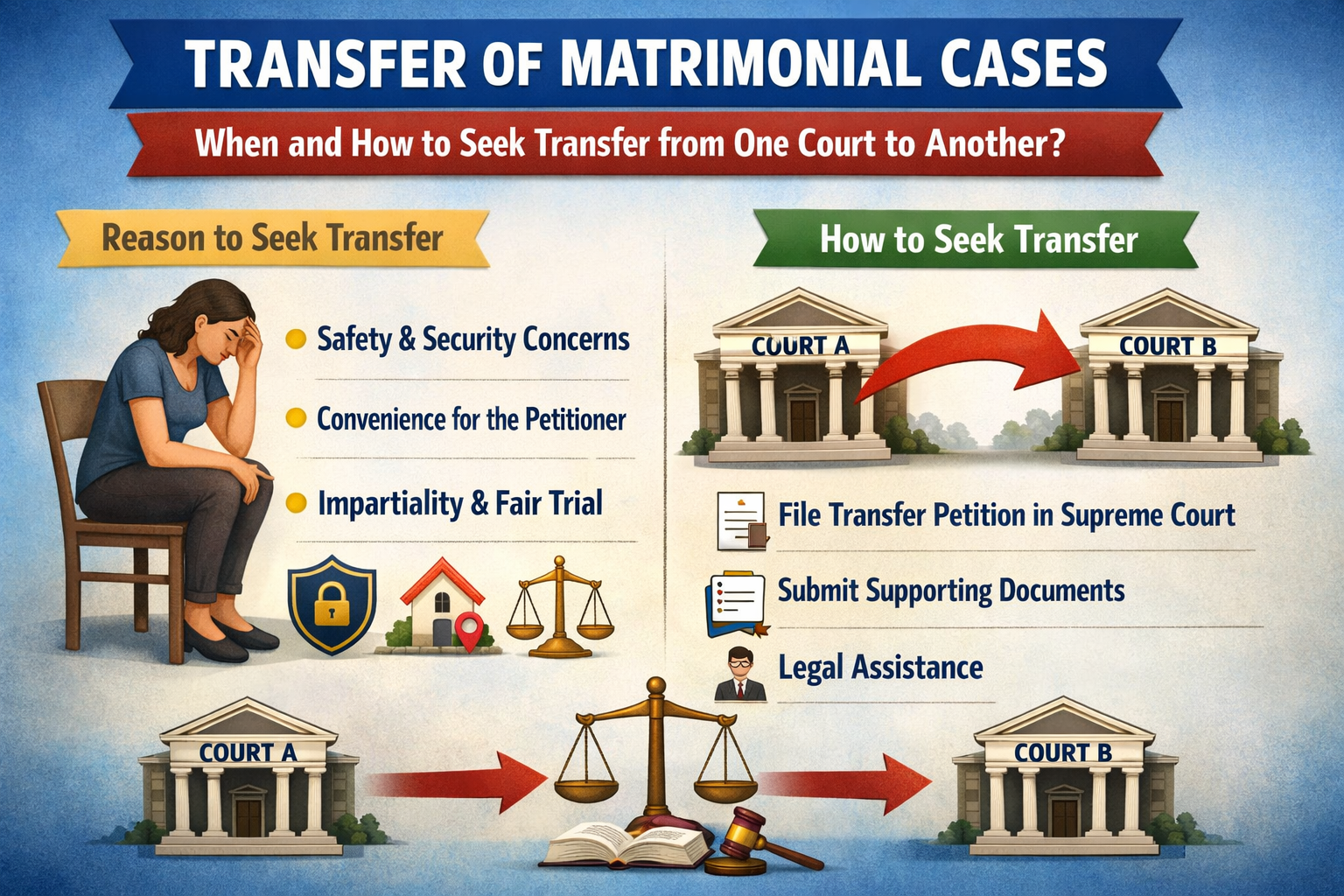
Transfer of Matrimonial Cases — When and How to Seek Transfer from One Court to Another ?
Matrimonial cases are deeply personal, but they often involve practical hardships — especially when one spouse files a case in a distant city or state.
For instance, a husband may file a divorce petition in his native place, while the wife lives and works in another city; or an NRI spouse may initiate proceedings abroad, leaving the other partner struggling to attend hearings.
To ensure fairness and accessibility, Indian law allows either party to seek a transfer of matrimonial proceedings from one court to another.
This article explains when such transfers can be requested, how the process works, and what the courts consider before granting them.
1. Legal Basis for Transfer of Matrimonial Cases
The power to transfer matrimonial cases in India depends on which court originally handles the matter:
(a) Supreme Court of India
Under Section 25 of the Code of Civil Procedure, 1908 (CPC), the Supreme Court can transfer any case, appeal, or proceeding from one High Court or subordinate court in one state to another in a different state.
(b) High Courts
Under Section 24 of the Code of Civil Procedure, 1908, the High Court has the power to transfer cases between:
- Two or more subordinate courts under its jurisdiction, or
- Withdraw a case from one court and assign it to another.
Thus:
Inter-state transfers → Filed before the Supreme Court (Section 25 CPC).
Intra-state transfers → Filed before the respective High Court (Section 24 CPC).
2. Typical Situations Where Transfer Is Sought
1.Wife’s convenience and safety:
Most transfer petitions are filed by wives who face hardship traveling long distances to attend court in another city or state.
2.Child custody and welfare:
When children live with one parent, courts prefer cases to be heard where the children reside for their comfort and schooling continuity.
3.Multiple connected cases:
If both spouses have filed related petitions (like divorce, maintenance, or domestic violence), courts often transfer them to one jurisdiction to avoid conflicting judgments.
4.Health, age, or financial hardship:
Elderly or unwell spouses can seek transfer citing inability to travel or afford distant litigation.
5.Safety and threat:
If a spouse fears harassment or intimidation at the other’s place, courts consider transfer essential for fair participation.
6.For NRIs:
Where one spouse lives abroad and proceedings are filed in India, the court may transfer cases to the city closest to the local family representative or POA holder for convenience.
3. Legal Procedure to File a Transfer Petition
Step 1: Drafting the Petition
The petition must clearly mention:
- Case number and court of origin,
- The court to which transfer is sought,
- Grounds for transfer (distance, safety, hardship, etc.), and
- Supporting documents such as proof of residence, medical certificates, or child details.
Step 2: Filing the Petition
For inter-state transfer: Filed before the Supreme Court of India (Transfer Petition under Section 25 CPC).
For intra-state transfer: Filed before the High Court (Transfer Civil Miscellaneous Petition under Section 24 CPC).
Step 3: Notice and Response
The respondent is served notice. The court may direct appearance or written objections.
Step 4: Hearing and Order
After hearing both parties, the court considers convenience, fairness, and the ends of justice before allowing or rejecting the transfer.
4. Key Principles Followed by Courts
The Supreme Court and High Courts follow certain broad principles when deciding transfer petitions in matrimonial cases:
(a) Convenience of the Wife
The Supreme Court has consistently held that in matrimonial disputes, the convenience of the wife is the primary consideration, especially if:
- She resides separately with minor children, or
- She lacks financial means to travel long distances.
Courts have recognized that women often face greater practical and social challenges in attending distant courts.
(b) Child’s Welfare
If a minor child is involved, the court prefers jurisdiction where the child resides, to minimize disruption to their life.
(c) Balance of Convenience
Courts assess which party faces greater genuine difficulty — not just inconvenience.
Transfer is granted only when hardship is substantial and real.
(d) Connected Cases
To avoid duplication and conflicting judgments, courts prefer to consolidate all related matrimonial cases (divorce, maintenance, custody, etc.) in one place.
(e) Misuse Prevention
Courts also guard against frivolous or mala fide petitions — the power to transfer is used to secure justice, not strategy.
5. Important Supreme Court Judgments
(i) Sumita Singh v. Kumar Sanjay (2002)
The Supreme Court held that the wife’s convenience must be the primary factor in deciding transfer petitions in matrimonial matters.
(ii) Anjali Ashok Sadhwani v. Ashok Kishinchand Sadhwani (2009)
The Court emphasized that hardship, distance, and family responsibilities of the wife justify transfer to her place of residence.
(iii) Arti Rani v. Dharmendra Kumar Gupta (2008)
Where multiple cases between the same parties were pending in different courts, the Supreme Court directed that all be heard together for judicial consistency.
(iv) Vaishali Shridhar Jagtap v. Shridhar Vishwanath Jagtap (2016)
The Court clarified that transfer petitions are not automatic — the applicant must demonstrate real hardship or disadvantage.
6. What the Court Considers Before Granting Transfer
- Distance between the two courts, and available transportation.
- Financial means and dependency of the petitioner.
- Age, health, and social circumstances.
- Presence of minor children and schooling stability.
- Availability of legal representation at both places.
- Any pending related proceedings.
The court’s focus is always “to ensure that the party at a disadvantage is not denied fair participation in justice.”
7. Cost and Timeframe
Transfer petitions are procedurally simple but may take:
- 3 to 6 months in High Courts, and
- 6 to 9 months in the Supreme Court (depending on listing).
Filing costs are moderate, and affidavits from the petitioner and supporting witnesses strengthen the case.
8. Practical Tips
- File early — ideally before evidence or trial begins.
- Provide supporting proof (distance, children’s school records, medical documents).
- Be factual, not emotional — courts respond to reason, not sentiment.
- If multiple cases exist, mention them all for consolidation.
- For NRIs: Ensure your Power of Attorney holder can represent you efficiently.
9. When Courts Refuse Transfer
Transfer is generally denied if:
- The petitioner fails to show genuine hardship.
- The other party offers to bear travel and accommodation expenses.
- The intention appears strategic or delaying.
Courts discourage misuse — ensuring the right to transfer remains a shield, not a weapon.
10. In Conclusion
Transfer petitions in matrimonial cases are not about convenience alone — they are about access to justice.
When distance, danger, or difficulty prevent one spouse from fairly participating in the proceedings, the court steps in to restore balance.
The law recognizes that justice must be practicable, not merely theoretical.
“No one should be forced to choose between safety and justice.”
Transfer powers under Section 24 and 25 CPC ensure that matrimonial disputes are heard where fairness — not geography — prevails.
“Courts may differ by location, but justice must always remain within reach.”